Neurons
This informative overview explains the intricate structure of neurons, including dendrites, the soma, and the axon, which play crucial roles in transmitting information through graded potentials and action potentials. It details the processes of depolarization and repolarization during action potential propagation, emphasizing the significance of myelination by Schwann cells and oligodendrocytes. The article also describes how myelination enhances conduction velocity through saltatory conduction, allowing swift communication between neurons. Essential for comprehending the nervous system's function.


Neurons
E N D
Presentation Transcript
Neurons Ted Miles
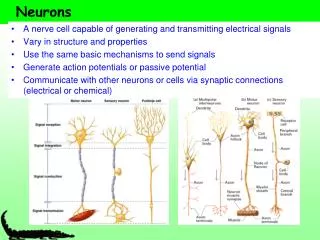
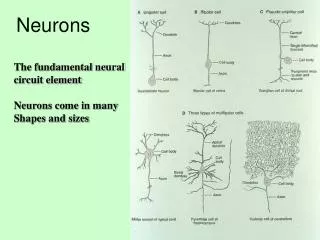
Neuron structure • Composed of: • Dendrites- receive information via neurotransmitters, then produce graded potentials. • Soma • Axon Hillock- responsible for making the decision to fire an action potential. • Axon-transmit action potentials to deliver information via neurotransmitters from the axon terminals.
Neuron conduction of Action Potential • An action potential occurs when there is a reversal of the normal resting potential (goes from negative to positive). Also called depolarization. • Depolarization occurs due to the opening of voltage gated Na channel allowing the influx of Na. Repolarization of the cell is due to Potassium efflux. • If membrane potential is excited to the threshold level an action potential is propagated
Myelination of Neurons • Produced by 2 types of cells • Acts as an insulator between ECF and INF • Schwann cells • PNS • Each axon is wrapped with many schwann cells leaving small gaps called nodes of Ranvier • Oligodendricytes • CNS • One cell produces extension to many different axons
Myelination of Neurons • Body has both myelinated and nonmyelinated fibers • Myelination increases conduction velocity of fiber due to saltatory conduction of the action potential • Action potential jumps from node of ranvier to the next without having to travel the entire length of the neuron
Terminal • Once the Cell reaches threshold and action potential is sent down the axon • Action potential reaches axon • Calcium is released into the cell • Synaptic vesicles release neurotransmitter into the synaptic cleft which diffuses to the receptors on the post-synaptic cell.
Bibliography • Widmaier, E.P., Raff, H., and Strang, K.T.; 2006. Vander’s Human Physiology, 10th edition. McGraw Hill.