Download
1 / 3
30 likes | 150 Vues
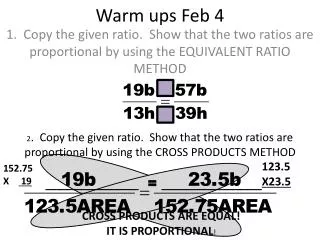
This lesson focuses on determining if two ratios are proportional using the cross products method and the equivalent ratio method. Students will analyze given ratios, such as 123.5:X and 152.75:X, and verify their proportionality through calculations. Additionally, the dimensions of a dollar bill (6 inches by 2.5 inches) and a fake dollar bill (8.75 inches by 3.75 inches) will be compared to establish if they are similar figures. This exercise emphasizes the importance of corresponding sides and their proportional relationships.

E N D
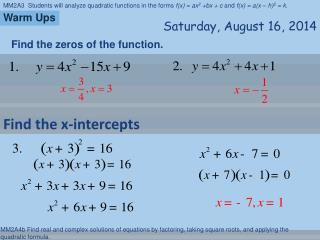
Warm ups Feb 4 2. Copy the given ratio. Show that the two ratios are proportional by using the CROSS PRODUCTS METHOD 1. Copy the given ratio. Show that the two ratios are proportional by using the EQUIVALENT RATIO METHOD 123.5 X23.5 152.75 X 19 _____________ = ______________ CROSS PRODUCTS ARE EQUAL! IT IS PROPORTIONAL!
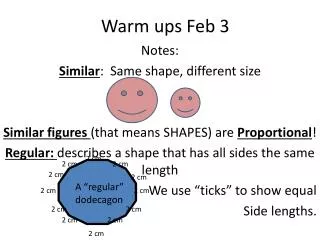
The dimensions of a dollar bill is 6 inches by 2.5 inches. The dimensions of Ms. Westbrook’s class fake dollar bill is 8.75 inches by 3.75 inches Are the two dollar bills proportional? Are they similar figures? Use your calculator and cross products to answer yes or no Notes- Copy: Similar figures have corresponding sides that are proportional. What does corresponding mean??
Copy: Corresponding means in the same location. Draw both arrows, label all corresponding sides with a variable