Download
1 / 8
80 likes | 207 Vues
This chapter explores the concepts of the Production Possibilities Curve (PPC), illustrating the maximum amounts of two goods that can be produced at full employment. It discusses key points on the curve, including full employment, unemployment, overemployment, and unattainable production. It also introduces the Law of Increasing Costs, emphasizing the trade-offs in production. Additionally, the chapter covers economic systems, comparing traditional, market, and command systems, highlighting their characteristics in terms of growth, freedom, and planning. Economic questions regarding production, methods, and target consumers are also examined.

E N D
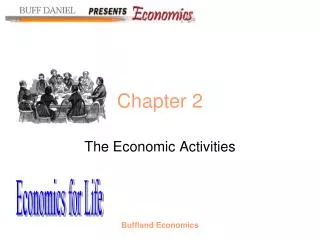
Chapter 2 The Economic Activities Buffland Economics
Production Possibilities Curve • Maximum amounts of two goods that can be produced at full employment • Graph • Points • 1. On – full employment • 2. Inside – unemployment • 3. Between the curves - overemployment • 4. Beyond - unattainable Buffland Economics
Law of Increasing Costs – as more of a good is produced you must give up larger amounts of the other good • Shifting the PPC • Increase the quantity and/or the quality of resources Buffland Economics
Economic Growth • Developing Countries – concentrate on capital goods Buffland Economics
Economic Systems Part 1 • Traditional – Inherited • Economic Stability, strong family, no innovation or modern conveniences • Based on Religion or Custom • Handed down • Score • No Economic Growth • No inflation • No Unemployment • No Economic Freedom Buffland Economics
Economic Systems Part 2 • Market (Capitalism) – runs itself • No central planning • Prices signal our behavior by providing incentives • Private property • Freedom of enterprise and choice • Self-interest • Competition • Adam Smith • Score • Economic growth • Inflation • Unemployment • Economic freedom Buffland Economics
Economic Systems Part 3 • Command (Socialism) – Imposed upon society • Central planning • Common property • No Freedom of Choice • Score • Economic Growth • No inflation • No unemployment • No Economic Freedom Buffland Economics
Questions a society must answer • What will be produced? • Goods that provide a profit • How will they be produced? • Least cost method of production • For whom are the goods produced? • Whoever has the money Buffland Economics