
Racing Strategy for the Ultimate Cycling Challenge
Prepare for an exhilarating cycling competition with six stages through nine towns, each demanding unique strategies. Riders will tackle at least 150 km but not exceed 200 km per stage. Key elements include individual timing for riders, team aggregation for the fastest three, and special classifications for the overall champion, King of the Mountains, and Sprint Cup. Participants must ensure two climb stages, one sprint stage, and adhere to elevation and road crossing rules. Gather insights on route planning, climb categories, and timing accuracy for the ultimate race experience.

Racing Strategy for the Ultimate Cycling Challenge
E N D
Presentation Transcript
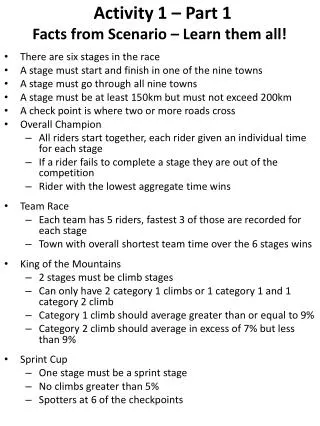
Activity 1 – Part 1 Facts from Scenario – Learn them all! • There are six stages in the race • A stage must start and finish in one of the nine towns • A stage must go through all nine towns • A stage must be at least 150km but must not exceed 200km • A check point is where two or more roads cross • Overall Champion • All riders start together, each rider given an individual time for each stage • If a rider fails to complete a stage they are out of the competition • Rider with the lowest aggregate time wins • Team Race • Each team has 5 riders, fastest 3 of those are recorded for each stage • Town with overall shortest team time over the 6 stages wins • King of the Mountains • 2 stages must be climb stages • Can only have 2 category 1 climbs or 1 category 1 and 1 category 2 climb • Category 1 climb should average greater than or equal to 9% • Category 2 climb should average in excess of 7% but less than 9% • Sprint Cup • One stage must be a sprint stage • No climbs greater than 5% • Spotters at 6 of the checkpoints
Activity 1 – Part 2 Decisions – Learn them ALL • Routes for each stage, making sure 1 stage is a sprint and 2 other stages are climb stages • Which stage will be a sprint stage, with no climbs greater than 5% • Which stages will be climb stages – either 2 cat 1 or 1 cat 1 and 1 cat 2 • Average Heights of climbs • Length of stages (more than 150km but less than 200km) Assumptions – Learn them ALL • That the pedometer has given accurate distances between checkpoints • Height measurements are accurate for each checkpoint. • Aggregated climb % are accurate based on the watch measurements. Remember – Activity, Name, Candidate No, Centre No in the Header or Footer
