Understanding Cellular Transport: Equilibrium, Active and Passive Processes
This overview delves into the concepts of equilibrium in cellular environments, highlighting how substances move across cell membranes. It explains the role of mitochondria in ATP production and contrasts active and passive transport mechanisms. Key processes such as diffusion, facilitated diffusion, and osmosis are defined, alongside their roles in achieving equilibrium. Additionally, the types of transport—endocytosis, phagocytosis, pinocytosis, and exocytosis—are discussed, providing insight into how cells interact with their surroundings.

Understanding Cellular Transport: Equilibrium, Active and Passive Processes
E N D
Presentation Transcript
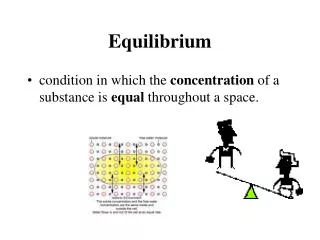
Equilibrium • condition in which the concentration of a substance is equal throughout a space.
ATP is associated with what Organelle? • Mitochondria • ATP (energy) is associated with which one, passive or active transport? • Active Transport • Draw a picture showing the process of passive diffusion and then write a brief description: • Diffusion usually results in _______________________ • Equilibrium
Figure A represents a cell in a(n) hypertonic hypotonic isotonic solution. How do you know? Figure B represents a cell in a(n) hypertonic hypotonic isotonic solution. How do you know? Figure C represents a cell in a(n) hypertonic hypotonic isotonic solution. How do you know?
A phospholipidbilayer has two parts: • Polar heads – • hydrophillic (love ______________) • Nonpolar tails – • hydrophobic (fear ______________) • Active transport – against the concentration gradient or with the concentration gradient (high to low or low to high)??
Bulk Transport • Endocytosis • into the cell thru vesicles • Phagocytosis – “PAC MAN” • the eating up movement of solid material into cells • Pinocytosis – Pino (Vino)cytosis – • cell drinking moment of liquids into cells • Exocytosis – • EXit – movement of particles out of cell
Name the 3 types of passive transport and compare them using a T-chart: NO NRG Movement of particles across the concentration gradient from hi to lo Involves a protein channel or carrier in order to move larger particles or charged particles from hi to lo The movement of water across a selectively-permeable membrane from hi to lo in order to achieve equilibrium Diffusion Facilitated Diffusion Osmosis
Carrier Protein Potassium ions in Added for energy boost ATP against Sodium-Potassium Pump Moves ___________ the concentration gradient Phospholipid Sodium ions out