Advancements in Neuro-Machine Interfaces for Movement Control and Rehabilitation
This presentation by James Patton, Ph.D., explores the innovative intersection of robotics and haptics in advancing human-machine interfaces. Supported by NIH and the Department of Education, the research focuses on neural adaptation, sensory-motor intelligence, and techniques for enhancing rehabilitation in stroke patients. Key topics include the role of augmented reality, bimanual coordination, postural control, and robotic teaching methods designed to improve hand-eye coordination. The study emphasizes the significance of feedback and repetitive practice in restoring movement functionality.

Advancements in Neuro-Machine Interfaces for Movement Control and Rehabilitation
E N D
Presentation Transcript
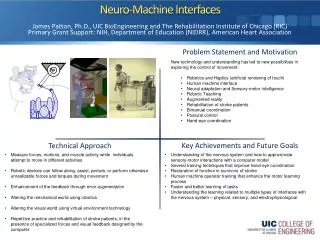
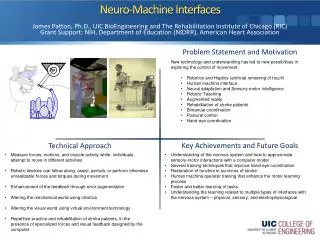
Neuro-Machine Interfaces James Patton, Ph.D., UIC BioEngineering and The Rehabilitation Institute of Chicago (RIC) Grant Support: NIH, Department of Education (NIDRR), American Heart Association • New technology and understanding has led to new possibilities in exploring the control of movement: • Robotics and Haptics (artificial rendering of touch) • Human machine interface • Neural adaptation and Sensory-motor intelligence • Robotic Teaching • Augmented reality • Rehabilitation of stroke patients • Bimanual coordination • Postural control • Hand-eye coordination • Measure forces, motions, and muscle activity while individuals attempt to move in different activities • Robotic devices can follow along, assist, perturb, or perform otherwise unrealizable forces and torques during movement • Enhancement of the feedback through error augmentation • Altering the mechanical world using robotics • Altering the visual world using virtual environment technology • Repetitive practice and rehabilitation of stroke patients, in the presence of specialized forces and visual feedback designed by the computer • Understanding of the nervous system and how to approximate sensory-motor interactions with a computer model • Several training techniques that improve hand-eye coordination • Restoration of function in survivors of stroke • Human machine operator training that enhance the motor learning process • Faster and better learning of tasks • Understanding the learning related to multiple types of interfaces with the nervous system – physical, sensory, and electrophysiological