Darwin notes
This summary explores Charles Darwin's groundbreaking theory of evolution, detailing how modern organisms evolved from ancient life forms. It highlights Darwin's observations during his voyage on the HMS Beagle, particularly in the Galapagos Islands, which led him to propose natural selection as the mechanism for evolution. Influenced by geologists Hutton and Lyell, Darwin recognized the Earth's immense age and the slow processes shaping it, which allowed life to evolve over time. The piece also reviews Lamarck's earlier theories, population dynamics, and evidence supporting evolutionary change.

Darwin notes
E N D
Presentation Transcript
Darwin notes CP Biology Ms. Morrison
Evolution • Change over time, process by which modern organisms have descended from ancient organisms
Theory • Well-supported testable explanation of phenomena that have occurred in the natural world
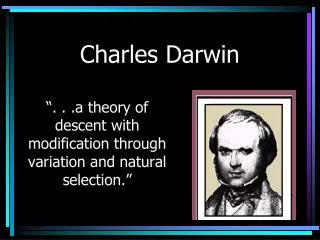
Charles Darwin • Traveled around world on HMS Beagle (1831) • Made numerous observations and collected evidence that lead to theory of evolution • Saw great diversity in plant and animal life • Collected fossils on his trip • Questioned fossils relationships to living organisms and wondered why they had disappeared
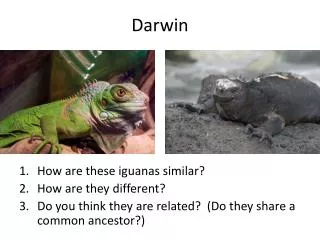
Galapagos Islands • Influenced Darwin the most • Group of small islands off west coast of South America • Although close – had very different climates • Observed that the characteristics of many animals and plants varied noticeably among the different islands
Ancient Earth • Until 19th century – thought world was only a few thousand years old and life was like it had always been • Studies of fossils lead to idea that several periods of creation • Two geologists – James Hutton and Charles Lyell – recognized Earth was many million years old and processes that changed Earth in the past were still working now
James Hutton • Published theory about geological forces that shaped Earth • Said layers of rock form very slowly – pushed up or buried, shaped by natural forces such as rain, heat, and cold • Proposed Earth to be much more than a few thousand years old
Charles Lyell • Principles of Geology • Scientists must explain past events in terms of processes that they actually observe since those processes that shaped Earth in past continue in present • Explained geological features could be built up or torn down over long periods of time
Geology and Darwin • Hutton and Lyell influenced Darwin two ways: • If Earth could change, might life also change? • Would have taken many, many years for life to change – Earth would have to be extremely old
Lamarck’s Theory of Evolution • Jean-Baptiste Lamarck – recognized living things changed over time and all species descended from other species • Realized that organisms somehow adapted to their environments • Published theory in 1809 • Proposed that selective use or disuse of organs – caused organisms to acquire or lose certain traits over their lifetimes – these could be passed to offspring and over time lead to change in the species • Incorrect – acquired behaviors NOT passed to offspring
Population Growth • Thomas Malthus – economist who observed in 1798 that babies were being born faster then people were dying • Reasoned that if human population grows unchecked, that sooner or later there would be insufficient living space and food for everyone • War, famine, and disease – work against population growth • Concept lead Darwin to realize this was true for plants and animals too • Darwin wondered what factors determine which organisms survive and reproduce and which do not
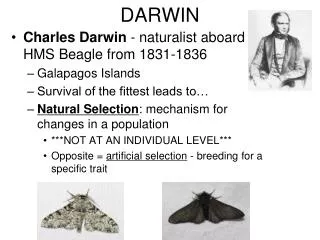
On the Origin of Species • Published in 1859 • Proposed mechanism for evolution was natural selection and proposed evidence for evolution • Said natural variation found in all types of organisms • Humans used selective breeding for particular natural variations found useful = artificial selection • Darwin felt a process like artificial selection occurred in nature
Darwin’s Theory • Struggle for existence = each member of a species completed to obtain food, living space, and other necessities of life • Fitness = ability of an individual to survive and reproduce in its environment • Said fitness result of adaptations (inherited characteristics) that increase an organisms’ chance of survival • Successful adaptations – enable organisms to become better suited to environment and better able to survive and reproduce
Darwin’s Theory, pg 2 • Survival of the fittest = individuals better suited to the environment (high fitness) would survive and reproduce most successfully = natural selection • Over time natural selection results in changes in inherited characteristics of a population which increases a species’ fitness in its environment
Descent with Modification • Living species descended with changes from other species over long periods due to natural selection • Means all living organisms related to one another • Principle = common descent = all species, living and extinct, are derived from common ancestors
Evidence for Evolution • Fossil Record – shows living things evolving for millions of years • Geographic distribution of living species • Some species become different when adapt to different local environments • Different species living in similar environments may evolve common features
Evidence for Evolution, pg 2 • Homologous body structures = structures which have different mature forms but develop from same embryonic tissues • Ex. 4 limbed animals with backbones have common ancestor • Some homologous structures do not serve important functions – vestigial organs – have become very reduced in size and not used in survival • Embryonic similarities – embryos of many animals with backbones look so similar it is hard to tell them apart • Same groups of embryonic cells develop in same order and in same patterns • Help produce homologous structures