
SlideServe
Menu
Préférences
© SlideServe · v2026

Bluetooth Technology

elmo avatar
15 diapositives · 1.1K Views · Aug 07, 2014

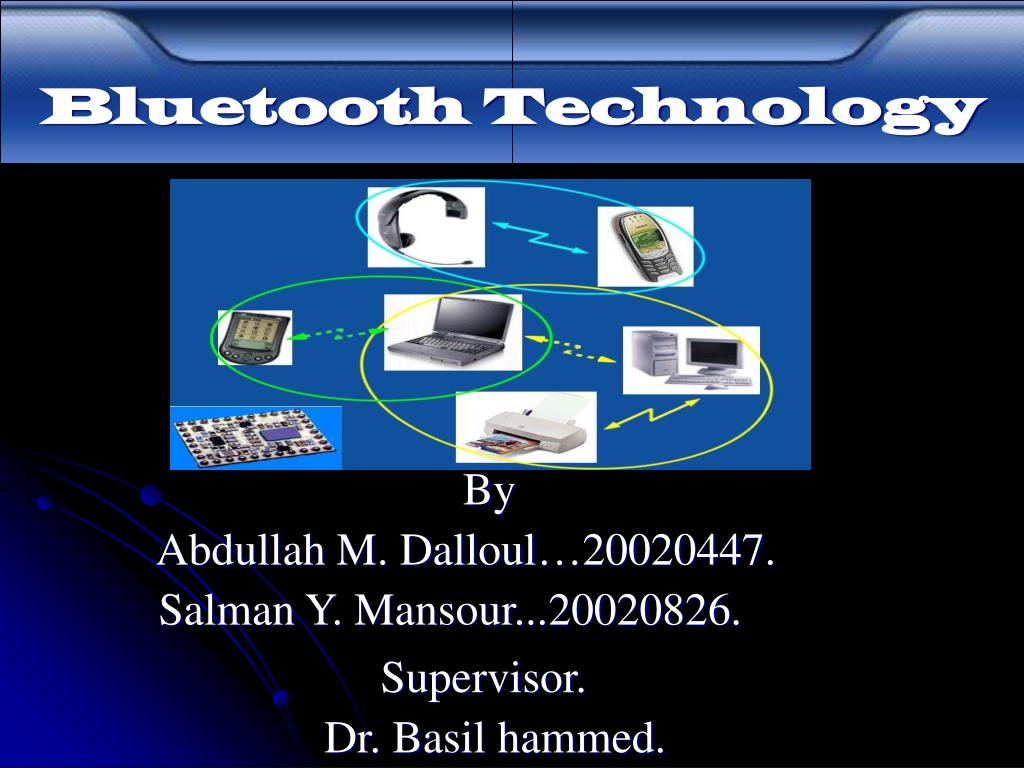
Bluetooth Technology. By Abdullah M. Dalloul…20020447. Salman Y. Mansour...20020826. Supervisor. Dr. Basil hammed. BLUETOOTH. Content. What is Bluetooth ? History Bluetooth Architecture Bluetooth system Network Topology Security Bluetooth benefits Conclusion. BLUETOOTH.
Bluetooth Technology - slide 1
01 / 15Bluetooth Technology
1 / 17

Télécharger la présentation

Bluetooth Technology
Une image / un lien ci-dessous est fourni (tel quel) pour télécharger la présentation

Politique de téléchargement : le contenu du site vous est fourni TEL QUEL pour votre information et votre usage personnel ; il ne peut être vendu, concédé sous licence ni partagé sur d’autres sites sans l’accord de son auteur.Le contenu vous est fourni TEL QUEL, pour votre information et votre usage personnel uniquement. Téléchargez la présentation en cliquant sur ce lien. Lors du téléchargement, si vous ne parvenez pas à télécharger une présentation, l’éditeur a peut-être supprimé le fichier de son serveur.Pendant le téléchargement, si vous ne parvenez pas à obtenir une présentation, le fichier a peut-être été supprimé par l’éditeur.

F I N

Plus de contenu associé

Transcription de la présentation
  1. Bluetooth Technology By Abdullah M. Dalloul…20020447. Salman Y. Mansour...20020826. Supervisor. Dr. Basil hammed.

  2. BLUETOOTH Content • What is Bluetooth ? • History • Bluetooth Architecture • Bluetooth system • Network Topology • Security • Bluetooth benefits • Conclusion

  3. BLUETOOTH What is Bluetooth? • A short-range wireless communications technology. • Low bandwidth, low power, voice and data transfer. • Adaptable to any type of electronic devices; Cell phones, laptops, PC`s, Cameras and scanners. • Automatic connections (no user prompting).

  4. BLUETOOTH History • Name came from Harold Blatand king of Denmark ( 940 - 981). • 1994 – Ericsson study on a wireless technology to link mobile phones and accessories. • 1998 the Special Interest Group (SIG) was founded by Ericcsson. • 1999 first Bluetooth production.

  5. BLUETOOTH The Special Interest Group (SIG) • Microsoft • Motorola • Nokia • Toshiba • Erricson • IBM • Intel • Agere systems

  6. BLUETOOTH Bluetooth Architecture • ISM Radio band (Industrial, Scientific and Medical) at2.4 - 2.48 GHz. • Range 10 - 100 m . • 1 Mbps Data Rate (750 Kbps in real). • Power consuming 1 milliwatt. • Embedded frequency chip into an electronic device.

  7. BLUETOOTH Bluetooth system • Consisting of a Bluetooth Module and a Bluetooth Host. • Module is partitioned into the radio unit, the baseband unit and the Host Controller firmware. • Host consists of the software protocol stack and the application software

  8. BLUETOOTH Host controller Continue… Bluetooth Host Bluetooth Host • Application software is the user specified and implements the device functionality. • Host Controller realizes communication between Module and Host. • Baseband is a controller, establishing and maintaining the connection. • Radio transceiver enables the wireless link between devices. Host drives and application HCI driver Events Data Commands Bluetooth Module Bluetooth Module Link Manager Baseband & link controller Radio unit

  9. BLUETOOTH Network Topology Piconet . Scatternet.

  10. BLUETOOTH Security • For each Bluetooth device there is:- • A 48 bit fixed public address that is unique for each device. • A 128 bits private user key which is derived during initialization and kept stable • A 128 bits random number which is generated randomly for each new transaction

  11. BLUETOOTH Bluetooth benefits: • Eliminates cables and wires between devices. • Facilitates both data and voice communication • Enables ad hoc networks between multiple Bluetooth devices. • Spread-spectrum frequency.

  12. BLUETOOTH Other wireless technologies: • IrDA The IrDA enables bidirectional infrared communication between the devices ( at least 1-meter / Typically, 2 meters). • HomeRF The HomeRF is designed to carry both voice and data and to inter-operate with the Public Switched Telephone Network and the Internet.

  13. BLUETOOTH Comparison of Technologies

  14. BLUETOOTH Conclusions • Bluetooth was originally intended to be a cable replacement. • Bluetooth is a global, RF-band (ISM band: 2.4GHz), short-range, low power, personal devices • Embedding Bluetooth chip into an electronic device will allow many devices to be Bluetooth-enabled.

  15. Thanks Thanks