Understanding T-Tests and One-Way ANOVA: Key Calculations and Assumptions
This guide provides an overview of the T-test for independent means, detailing how to calculate the test statistic (T) and the significance of the results. It emphasizes the pooled variance calculation and the importance of degrees of freedom in determining the total variability. Additionally, it covers assumptions necessary for One-Way ANOVA, including independence, normality, and equal variances among groups. Understand how to calculate between-groups and within-groups variability, and interpret the F-statistic to assess the significance of differences across multiple groups.

Understanding T-Tests and One-Way ANOVA: Key Calculations and Assumptions
E N D
Presentation Transcript
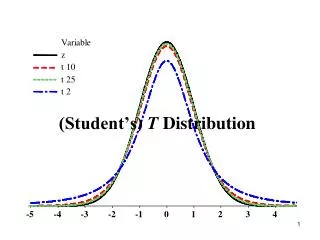
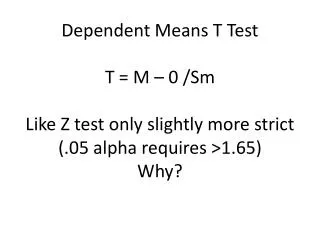
Dependent Means T TestT = M – 0 /SmLike Z test only slightly more strict(.05 alpha requires >1.65)Why?
T test for independent means T = (M1 – M2) / Sdifference Df total = df1 + df2 S2 difference is S2m1 + S2m2 S2m1 is S2Pooled/N1 S2Pooled is df1/df (S21) + df2/df (S22)
One way ANOVA • Assumptions • Independence • Normality • Equal variance of groups • Calculations • Between groups variability: • S2B = Σ ni * (Mi – GM) 2 /dfB [dfB = NGroups-1] • Larger value means bigger gap between groups so increases reason to reject null hypothesis. Numerator of F • Within groups variability: • S2W = Σ (XiG –MG) 2 / dfW [dfW is sum of group df’s] • Larger value means more overlap so decreases reason to reject NH so is the denominator of F • F = S2B / S2W look up alpha criterion using dfB AND dfW