Genes and How They Work
This chapter explores the fundamental principles of gene function, detailing how information flows from DNA to RNA, and ultimately to proteins via transcription and translation. It covers the genetic code, types of RNA (mRNA, rRNA, tRNA), the processes of gene expression including splicing, and the essential roles of ribosomes in protein synthesis. Additionally, it addresses mutations and their impact on genetic variation, highlighting their significance in evolutionary processes while noting the potential harms of excessive genetic change.

Genes and How They Work
E N D
Presentation Transcript
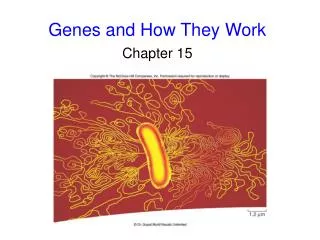
Genes and How They Work Chapter 15
The Nature of Genes information flows in one direction: DNA (gene) RNA protein Transcription Translation
The Genetic Code codon: set of 3 nucleotides(mRNA) that specifies a particular amino acid (64 possible codons) stop codons: (UUA, UGA, UAG) used to terminate translation start codon: (AUG) used to start translation
Gene Expression Overview template strand: used to make RNA coding strand: complementary to the template strand RNA polymerase: puts nucleotides together to make RNA strand
Gene Expression Overview types of RNA: messenger RNA (mRNA) carries the info from DNA that encodes proteins ribosomal RNA (rRNA) part of ribosome transfer RNA (tRNA) carries amino acids to the ribosome
Transcription Transcription proceeds through: • initiation • elongation – RNA nucleotides are added to the 3’ end of the new RNA • termination
Eukaryotic pre-mRNA Splicing • introns – non-coding sequences • exons – sequences that will be translated
tRNA and Ribosomes tRNA • amino acids carried by the acceptor arm • the anticodon loop 3 nucleotides complementary to mRNA codons
tRNA and Ribosomes The ribosome has two primary functions: • decode the mRNA • form peptide bonds
Translation • initiation • elongation – tRNAs bring amino acids to the ribosome • Termination – stop codon
Mutation: Altered Genes Point mutations alter a single base. Chromosomal mutations change part of a chromosome (deleted/repeated/moved)
Mutation: Altered Genes Too much genetic change (mutation) can be harmful to the individual. However, genetic variation (caused by mutation) is necessary for evolutionary change of the species.