Download
1 / 10
100 likes | 248 Vues
This comprehensive guide covers the fundamentals of RNA and protein synthesis, explaining the key differences between RNA and DNA, including the structural components of RNA. It details the three types of RNA—messenger RNA (mRNA), transfer RNA (tRNA), and ribosomal RNA (rRNA)—and the processes of transcription and translation. Readers will learn about genetic coding in sequences of three bases (codons) and the steps involved in protein synthesis. For further clarity, interactive animations are provided to enhance understanding of these complex biological processes.

E N D
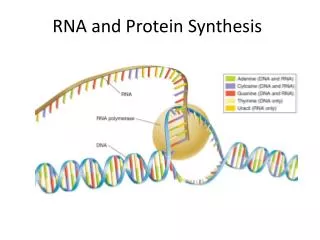
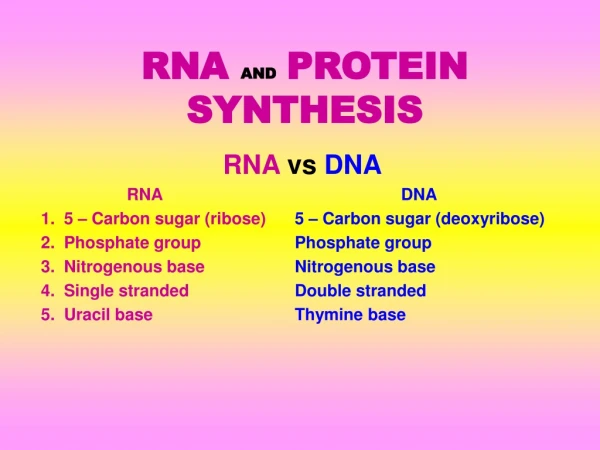
RNA RiboNucleicAcid Like DNA: • Consists of nucleotides Unlike DNA: • Ribose sugar, not Deoxyribose • RNA is single stranded • RNA contains Uracil in place of Thymine • Can leave the nucleus
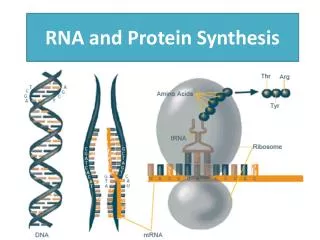
Types of RNA Messenger RNA (mRNA) • Takes the code from DNA out of the nucleus Transfer RNA (tRNA) • Contains the exact opposite code of mRNA • Brings over amino acids to build proteins Ribosomal RNA (rRNA) • Makes up ribosomes
DNA -----> RNA -----> Protein • PROTEIN SYNTHESIS (making proteins) • Going from DNA to RNA is called Transcription • Going from RNA to Protein is called Translation
Reading the Genetic Code • The genetic code (DNA or RNA) is read in a sequence of 3 bases at a time. • Example: AUUGAGCGUCCU • Every 3 bases on an mRNA strand called a “codon” • Every 3 bases on a tRNA strand called an “anticodon”
Steps in Protein Synthesis • DNA untwists and unzips. • mRNA is formed from the one side of the DNA molecule called the template side. • mRNA travels out of the nucleus and attaches to a ribosome
tRNA joins the mRNA at the ribosome. Each tRNA contains 3 bases and has an amino acid attached to it. • Once each tRNA drops off its amino acid, the amino acids bond to each other. (polypeptide bond) • When the amino acid chain is complete, the mRNA and tRNA break away leaving only the newly formed protein chain, aka a polypeptide.
CONFUSED???? • This process is hard to understand by simply reading a set of steps, so click on the links below to see different animations of this process: • www.youtube.com/watch?v=NJxobgkPEAo • www.learnerstv.com/animation/biology/Proteinsynthesis.swf • http://www.americanbookcompany.com/science/