Justifying Conclusions Using Proofs: Properties, Postulates, Definitions, and Theorems
This lesson focuses on constructing logical justifications for conclusions drawn from various mathematical statements. Students will explore how to state the necessary properties, postulates, definitions, or theorems that support each conclusion, such as solving equations, proving the equality of segments, and identifying the measures of angles. Through multiple examples involving equations and geometric properties, learners will develop critical reasoning skills to articulate their justifications clearly and effectively.

Justifying Conclusions Using Proofs: Properties, Postulates, Definitions, and Theorems
E N D
Presentation Transcript
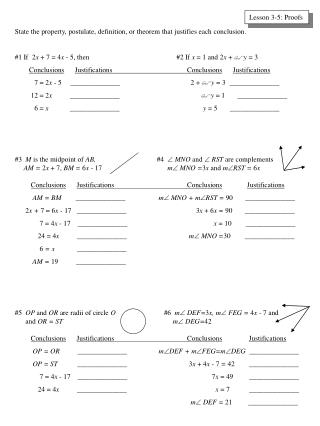
Lesson 3-5: Proofs State the property, postulate, definition, or theorem that justifies each conclusion. #1 If 2x + 7 = 4x - 5, then #2 If x = 1 and 2x + y = 3 ConclusionsJustifications ConclusionsJustifications 7 = 2x - 5 ______________ 2 + y = 3 ______________ 12 = 2x ______________ y = 1 ______________ 6 = x ______________ y = 5 ______________ #3 M is the midpoint of AB, #4 MNO and RST are complements AM = 2x + 7, BM = 6x - 17 m MNO =3x and mRST = 6x ConclusionsJustifications ConclusionsJustifications AM = BM ______________m MNO +mRST = 90 ______________ 2x + 7 = 6x - 17 ______________ 3x + 6x = 90 ______________ 7 = 4x - 17 ______________ x = 10 ______________ 24 = 4x ______________ m MNO =30 ______________ 6 = x ______________ AM = 19 ______________ #5 OP and OR are radii of circle O #6 m DEF=3x,m FEG = 4x - 7 and and OR = ST m DEG=42 ConclusionsJustifications ConclusionsJustifications OP = OR ______________mDEF +mFEG=mDEG______________ OP = ST ______________ 3x + 4x - 7 = 42 ______________ 7 = 4x - 17 ______________ 7x = 49 ______________ 24 = 4x ______________ x = 7 ______________ m DEF = 21 ______________
#1 If 2x + 7 = 4x - 5, then #2 If x = 1 and 2x + y = 3 ConclusionsJustifications ConclusionsJustifications 7 = 2x - 5 ______________ 2 + y = 3 ______________ 12 = 2x ______________ y = 1 ______________ 6 = x ______________ y = 5 ______________ #3 M is the midpoint of AB, #4MNO and RST are complements AM = 2x + 7, BM = 6x - 17 m MNO =3x & mRST = 6x ConclusionsJustifications ConclusionsJustifications AM = BM _________m MNO +mRST = 90 _________ 2x + 7 = 6x - 17 _________ 3x + 6x = 90 _________ 7 = 4x - 17 _________ x = 10 _________ 24 = 4x __________ m MNO =30 _________ 6 = x __________ AM = 19 __________ #5 OP and OR are radii of circle O #6mDEF=3x,mFEG = 4x - 7 & and OR = ST m DEG=42 ConclusionsJustifications ConclusionsJustifications OP = OR _________mDEF +mFEG=mDEG________ OP = ST _________ 3x + 4x - 7 = 42 ________ 7 = 4x - 17 _________ 7x = 49 _______ 24 = 4x __________ x = 7 ______ m DEF = 21 ______________