The First Christians
300 likes | 343 Vues
Explore how Christianity gained followers, diverged from Judaism, and faced challenges. Learn about Jesus, Peter, and Paul's roles. Understand Roman rule and the establishment of the Christian church.


The First Christians
E N D
Presentation Transcript
The First Christians Chapter 10, Section 1, page 342
Objectives After this lesson, students will be able to: discuss how Jesus of Nazareth won followers by preaching of God’s love and forgiveness, but was eventually crucified. explain Christianity, based on Jesus’ teachings, and how it became a separate religion from Judaism.
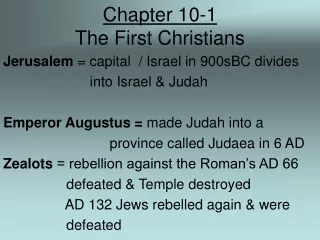
Roman Rule – page 343 • The Romans took over the territory of Judah in 63 B.C. • Augustus made the area into a Roman province named Judaea in A.D. 6. • not an entirely happy place → rebellion A.D. 66 • Another rebellion in A.D. 132 led to Jews being banned from Jerusalem (Jewish Diaspora).
The Life of Jesus – page 344 • Jewish hopes for a messiah (deliverer) • Jesus of Nazareth • preacher/teacher who travelled throughout Judaea and Galilee • disciples – twelve close followers of Jesus
What Did Jesus Teach? – page 344 • urged people to turn away from sins • stressed relationship with God • Sermon on the Mount • love and forgiveness • love your neighbor • parables – a story that uses everyday life events to express spiritual ideas
What is the Crucifixion? – page 347 • Jesus’ teachings made some people uncomfortable. • c. A.D. 33 – Jesus went to Jerusalem for Passover • arrested for treason • crucifixion – Rome’s punishment of political rebels and lower class criminals • According to Christian tradition, Jesus’ resurrection (to rise from the dead) followed his death.
The First Christians – page 348 • spread of the message following Jesus’ death • Christ comes from Christos, Greek for “messiah” • Early Christians met in homes to worship.
Who Were Peter and Paul? – page 348 • apostle – an early Christian leader who helped set up churches • early founders of Christian churches: • Peter • one of the twelve disciples • went to Rome following Jesus’ death and helped to set up a church there • Paul of Tarsus • conversion on the road to Damascus • spread the message of Jesus • epistles • probably killed when Nero ordered the persecution of the Christians
What Do Christians Believe? – page 350 • Christians believe • that Jesus is the Son of God. • that if people accept Jesus and his teachings they will gain salvation (to be saved from sin and allowed to enter heaven). • in the Holy Trinity (one God in three beings: the Father, the Son, and the Holy Spirit).
The Christian Church Chapter 10, Section 2, page 351
Objectives After this lesson, students will be able to: • explain how Christianity won many followers and eventually became the official religion of the Roman Empire. • discuss how early Christians set up a church organization and explained their beliefs.
A Growing Faith – page 352 • spread of Christian faith
A Growing Faith – page 352 • spread of Christian faith
A Growing Faith – page 352 • Why was Christianity successful? • positive message of hope, love and salvation • old religions focused on the state • ideas were familiar • inclusive religion– all are welcome • Roman persecutions
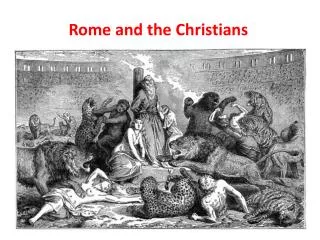
Roman officials saw the Christians as a threat to the security of the empire. refusal to worship Roman gods (emperor’s cult) refusal to serve in the military persecution of Christians results in martyrs – people willing to die for their beliefs backfired on the persecutors How did the Romans Treat Christians? page 353
Diocletian – last great persecution of the Christians Constantine Battle of Milvian Bridge ended persecutions of Christians Rome Adopts Christianity – page 354
Rome Adopts Christianity – page 354 • Edict of Milan (A.D. 313) – issued by Constantine, this order gave religious freedom to all people and legalizing Christianity • Theodosius, Constantine’s successor, made Christianity Rome’s official religion.
Early Christians organized the church as a hierarchy (an organization with different levels of authority). clergy – leaders of the church laity – regular church members doctrine – official church teaching The Early Church – page 355
What is the New Testament? – page 355 • The Gospels(means “good news”), which record the life and teachings of Jesus, together form part of the New Testamentof the Bible. • Augustine – Church Father who wrote The City of God and Confessions
Who is the Pope? – page 356 • By A.D. 600, thebishop of Rome had gained a special title – pope. • claimed the authority of Peter • diocese was in Rome • head of the Roman Catholic Church
Chapter 10, Section 2 Questions • Why was Christianity so successful? • How was the Roman persecution of the Christians counterproductive? • What is a martyr? • Explain the importance of the Edict of Milan. • How was the leadership of the early Christian church organized? • The _____ include a record of the life and teachings of Jesus, and are a part of the New Testament.
The Spread of Christianity Chapter 10, Section 3, page 358
The Byzantine Church – page 359 • The church and government worked closely together in the Byzantine Empire. • In the Byzantine Empire, the Emperor controlled the Church as well as the government. (caesaropapism) • emperor chose the patriarch • emperor crowned in a religious ceremony
Religious Arguments – page 359 • relationship between Jesus and God • c. A.D. 700 – arguments over icons – images of Jesus, Mary, or saints honored by some Christians • idol worship? • A.D. 726 – Emperor Leo III ordered removal → iconoclasts – image breakers
Conflicts Between Churches – page 360 • pope’s claims of authority • failure to cooperate • differences in politics and culture • pope and the patriarch of Constantinople excommunicated (excommunicate – to declare that a person or group no longer belongs to the church)
Conflicts Between Churches – page 360 • A.D. 1054 –church split (schism) into the Roman Catholic Church and the Eastern Orthodox Church (form of Christianity based on Greek heritage practiced in the Byzantine Empire)
What Are Monasteries? – page 362 • monastery – a religious community of monks • men = monks • women = nuns • tried to live simple lives centered on Christian ideals • preservation of Greek and Latin writings • community services • served as missionaries
What Are Monasteries? – page 362 • Basil – developed the Basilian Rule, model for Eastern Orthodox religious life • Benedict – developed the Benedictine Rule, became religious model in the West • Cyril and Methodius – Byzantine missionary brothers who carried the Christian message to the Slavic people. • Patrick – brought Christianity to Ireland