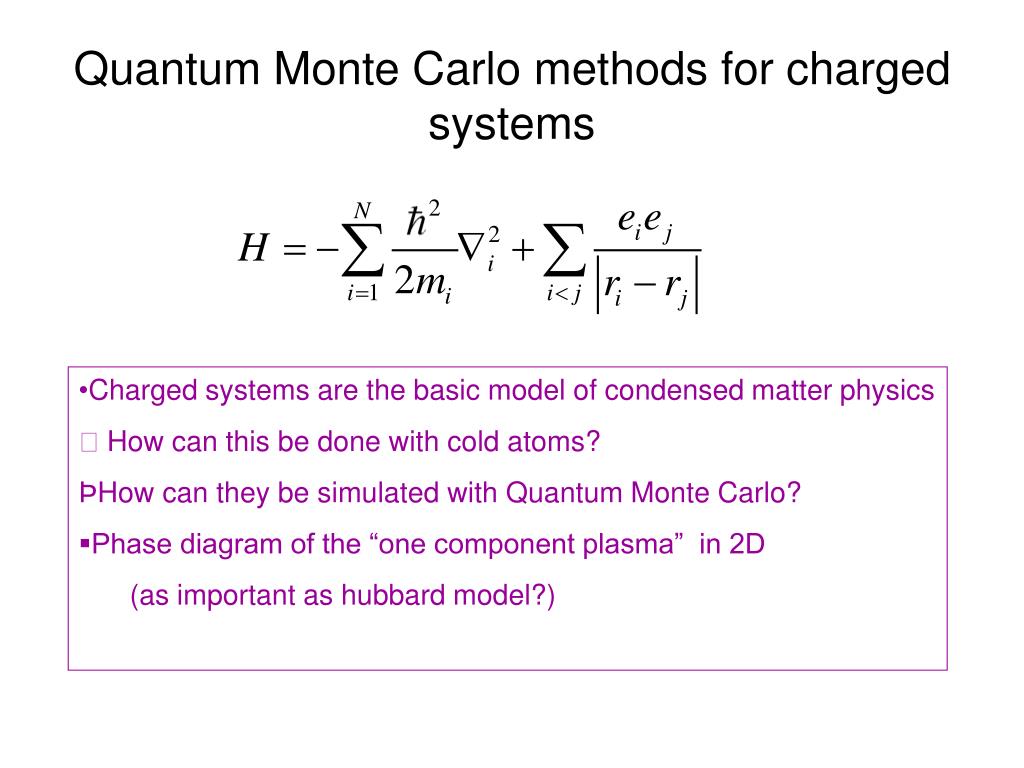
Quantum Monte Carlo methods for charged systems • Charged systems are the basic model of condensed matter physics • How can this be done with cold atoms? • How can they be simulated with Quantum Monte Carlo? • Phase diagram of the “one component plasma” in 2D • (as important as hubbard model?)
Which ensemble? T=0 VMC (variational) DMC/GFMC (projector) or T>0? PIMC (path integrals) Which basis? Particle Coordinate Space Sz representation for spin Occupation Number Lattice models Wave functions Hartree-Fock Slater-Jastrow Backflow, 3 body Localized orbitals in crystal Many different quantum Monte Carlo methods • Which Hamiltonian? • Continuum • Lattice (Hubbard, LGT)
Imaginary-time path integrals The thermal density matrix is: • Trotter’s theorem (1959):
“Distinguishable” particles within PIMC • Each particle is a ring polymer; an exact representation of a quantum wavepacket in imaginary time. • Integrate over all paths • The dots represent the “start” of the path. (but all points are equivalent) • The lower the real temperature, the longer the “string” and the more spread out the wavepacket. • Path Integral methods can calculate all equilibrium properties without uncontrolled approximations • We can do ~2000 charges with ~1000 time slices.
Bose/Fermi Statistics in PIMC • Average by sampling over all paths and over connections. • At the superfluid transition a “macroscopic” permutation appears. • This is reflection of bose condensation within PIMC. • Fermion sign problem: -1 for odd permutations.
Projector Monte Carlo (T=0)aka Green’s function MC, Diffusion MC • Automatic way to get better wavefunctions. • Project single state using the Hamiltonian • This is a diffusion + branching operator. • Very scalable: each walker gets a processor. • This a probabilityfor bosons/boltzmanons since ground state can be made real and non-negative. • Use a trial wavefunction to control fluctuations and guide the random walk; “importance sampling” • For a liquid we use a Jastrow wavefunction, for a solid we also use Wannier functions (Gaussians) to tie particles to lattice sites. • More accurate than PIMC but potentially more biased by the trial wavefunction.
How can we handle charged systems? • If we cutoff potential : • Effect of discontinuity never disappears: (1/r) (r2) gets bigger. • Will not give proper plasmons because Poisson equation is not satisfied • Image potential solves this: VI = v(ri-rj+nL) • But summation diverges. We need to resum. This gives the Ewald image potential. • For one component system we have to add a background to make it neutral (background comes from other physics) • Even the trial function is long ranged and needs to be resummed.
Computational effort O(N3/2) O(N) O(N3/2) O(N3/2) O(N1/2) O(1) • r-space part same as short-ranged potential • k-space part: • Compute exp(ik0xi) =(cos (ik0xi), sin (ik0xi)), k0=2/L. • Compute powers exp(i2k0xi) = exp(ik0xi )*exp(ik0xi) etc. Get all values of exp(ik . ri) with just multiplications. • Sum over particles to get k for all k. • Sum over k to get the potentials. Constant terms to be added. Table driven method used on lattices is O(N2). For N>1000 faster methods are known.
Fixed-node method • Impose the condition: • This is the fixed-node BC • Will give an upper bound to the exact energy, the best upper bound consistent with the FNBC. • f(R,t) has a discontinuous gradient at the nodal location. • Accurate method because Bose correlations are done exactly. • Scales well, like the VMC method, as N3. • Can be generalized from the continuum to lattice finite temperature, magnetic fields, …
Dependence of energy on wavefunction3d Electron fluid at a density rs=10Kwon, Ceperley, Martin, Phys. Rev. B58,6800, 1998 • Wavefunctions • Slater-Jastrow (SJ) • three-body (3) • backflow (BF) • fixed-node (FN) • Energy <f |H| f> converges to ground state • Variance <f [H-E]2f> to zero. • Using 3B-BF gains a factor of 4. • Using DMC gains a factor of 4. FN -SJ FN-BF
The 2D one component plasmaPRL 103, 055701 (2009); arXiv:0905.4515 (2009) • Electrons or ions on liquid helium • Semiconductor MOSFET • charged colloids on surfaces • We need cleaner experimental systems! • Bryan Clark, UIUC & Princeton • Michele Casula, UIUC & Saclay, France • DMC UIUC • Support from: NSF-DMR 0404853
Phase Diagram for 2d boson OCP(up to now) Hexatic phase G ~124 Classical plasma T (mR) Quantum-classical crossover Electrons on helium electrons Quantum fluid Wigner crystal 1 / rs =(density)1/2 rs ~ 60 ~ 3x1012 cm2 De Palo, Conti, Moroni, PRB 2004.
Inhomogenous phases Maxwell construction • Cannot have 2-phase coexistence at first order transition! the background forbids it • Jamei, Kivelson and Spivak [Phys. Rev. Lett. 94, 056805 (2005)] “proved” (with mean field techniques) that a 2d charged system cannot make a direct transition from crystal to liquid • a stripe phase between liquid and crystal has lower energy • Does not prove that stripes are the lowest energy state, only that the pure liquid or crystal is unstable at the transition assume Boltzmann statistics – no fermion sign problem. F area
snapshots 122<G<124 classical quantum Triangular lattice forms spontaneously in PIMC
Structure Factors PIMC Exper. Keim, Maret, von Grunberg. Classical MC
Hexatic order r He,Cui,Ma,Liu,Zou PRB 68,195104 (2003). Muto , Aoki PRB 59, 14911(1999) r
2d OCP Phase Diagram PRL 102,055701 (2009) Clausius-Clapeyron relation : First order transition is on “nose” Hexatic phase Classical plasma T (mR) Wigner crystal Quantum fluid 1 / rs
Transition order differs from KT? Internal energy vs T ? 2nd order 1st order T (mR) 1 / rs T(mR)
Unusual structure in peak of S(k) Could be caused by many small crystals rs=65, N=2248
Structures exist in transition region • Are structures real? Or an ergodic problem • Are they different from a liquid? • Can we make a ground state model? Not one that is energetically favorable.
2D Bose OCP superfluid Normal fluid hexatic • Wigner crystal T (mR)
2dOCP fermion Phase diagram • 2d Wigner crystal is a spin liquid. • Magnetic properties are nearly divergent at melting (2d) and (nearly) 2nd order melting. • But sign problem? UNKNOWN Quantum Fluid Super-conductor?
Polarization transition Phase Diagram of 3DEG • second order partially polarized transition at rs=52 like the Stoner model (replace interaction with a contact potential) • Antiferromagnetic Wigner Crystal at rs>105
Conclusions • Long-ranged interactions are not an intractable problem for simulation. • We have established the outlines of the OCP phase diagram for boltzmannons and bosons. • Evidence for intervening inhomogeneous phases is weak • Future work: fermi statistics – but the “sign problem” makes the fluid phases challenging (not hopeless). • The OCP is a good target for a “quantum emulator.” • With optical lattice+disorder one can reach some of the most important problems in CMP.