Adaptive Transmit Signal Design for Multi-Aperture Radar Targets
This project focuses on reducing uncertainty in target detection by maximizing information in observations. Multi-Aperture Radar with adaptive transmit signals can improve target estimation and detection in both space and time domains. The aim is to construct optimal transmit signals for enhanced radar performance.

Adaptive Transmit Signal Design for Multi-Aperture Radar Targets
E N D
Presentation Transcript
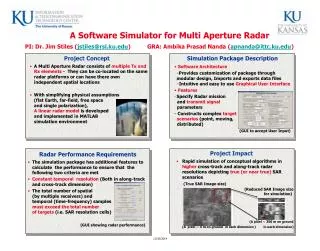
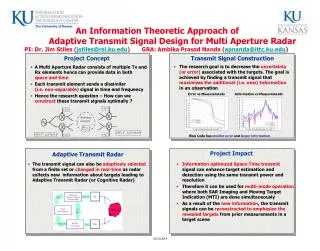
illuminated targets An Information Theoretic Approach of Adaptive Transmit Signal Design for Multi Aperture Radar PI: Dr. Jim Stiles (jstiles@rsl.ku.edu) GRA: Ambika Prasad Nanda (apnanda@ittc.ku.edu) Transmit Signal Construction Project Concept • The research goal is to decrease the uncertainty (or error) associated with the targets. The goal is achieved by finding a transmit signal that maximizes the additional (i.e. new) Information in an observation Error vs MeasurementsInformation vs Measurements Blue Code has smaller error and larger information • A Multi Aperture Radar consists of multiple Tx and Rx elements hence can provide data in both space and time • Each transmit element sends a dissimilar (i.e.non-separable) signal in time and frequency • Hence the research question – How can we construct these transmit signals optimally ? Project Impact Adaptive Transmit Radar • The transmit signal can also be adaptively selected from a finite set or changed in real-time asradar collects new information about targets leading to Adaptive Transmit Radar (or Cognitive Radar) • Information optimized Space-Time transmit signal can enhancetarget estimation and detectionusing the same transmit power and resolution • Therefore it can be used for multi-mode operation whereboth SAR Imaging and Moving Target Indication (MTI) are done simultaneously • As a result ofthe new information, thetransmit signalscan be reconstructed to emphasize the revealed targets from prior measurements in a target scene