Understanding Work and Energy: Concepts and Calculations
This comprehensive guide explores the fundamental concepts of work and energy in physics. Work is defined as the amount of energy transferred to an object by a force over a distance, measured in Joules (J). Key examples illustrate how work is calculated, including scenarios involving friction, gravity, and springs. The guide emphasizes the sign of work, distinguishing between positive and negative work based on energy transfer. Through practical examples and calculations, readers will gain a solid understanding of how these principles apply in real-world situations.

Understanding Work and Energy: Concepts and Calculations
E N D
Presentation Transcript
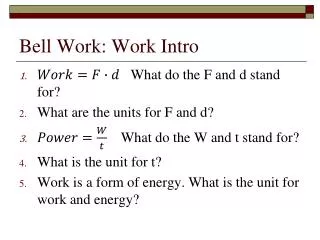
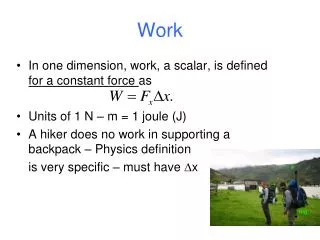
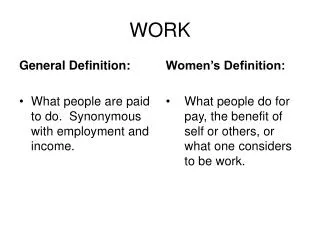
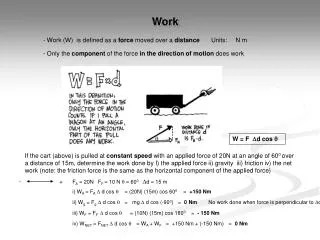
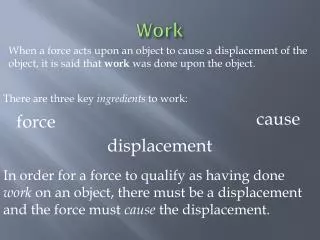
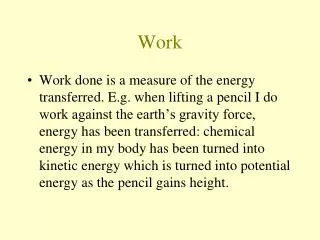
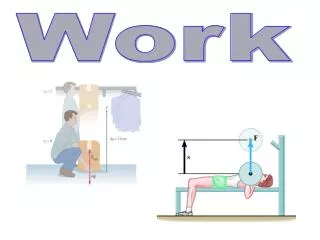
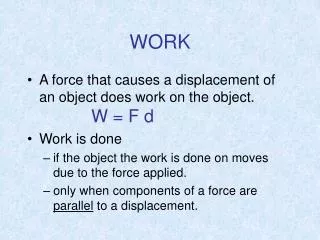
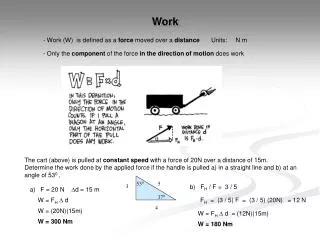
Work • Defined as the amount of energy transferred to an object by a force over a distance. • Calculated by: • Joule (J): SI unit of work and energy. • 1 Nm = 1 J • Where: • W=work (J) • F = Force magnitude (N) • ∆d= displacement (m)
Example 1 • Mike’s car has run out of gas. He exerts 45N of force over 500m to push his car to the gas station. How much work was done on the car?
Work has signs! • When work (or energy) is being put into a system, we say that it is positive work. • When work (or energy) is being extracted from a system, we say that it is negative work.
Example #2 • A toboggan carrying two children (mass = 60kg) is sliding on a snowy surface with a coefficient of friction of 0.11 and comes to a stop in 25m. • Draw the FBD for this system. • Calculate the magnitude of the frictional force • Calculate the work done by the kinetic friction on the toboggan. • What sign would this work have?
Work & Gravity • To lift an object, an individual applies a force equal in magnitude but opposite in direction to that object’s weight. • Recall: • Eg.3: How much work is done to lift a 30kg object 3m into the air?
Work & Springs • Springs exert a force which depends on the displacement of its end. • How much it is either stretched, compressed or twisted. • Since the force changes, we need a new approach since our equation works for constant force ONLY ( )
Example #4 • Data for a spring is given to the right. • Create a force vs. displacement graph • By calculating the area under the curve, determine the work done to stretch the spring • 0.2m • 0.5m • Determine the slope of the line. • This is called the spring constant