Understanding Ecosystems: Interactions, Energy Flow, and Trophic Levels
This chapter explores the intricate relationships within ecosystems, focusing on the interactions between biotic (living) and abiotic (non-living) components. It defines ecosystems, their boundaries, and processes such as photosynthesis and respiration. The chapter explains energy flow and productivity in ecosystems, highlighting producers, consumers, and decomposers. The concepts of food chains and food webs are clarified, demonstrating the energy transfer and ecological efficiency among trophic levels. It emphasizes the critical role of ecosystems in maintaining balance and supporting life on Earth.

Understanding Ecosystems: Interactions, Energy Flow, and Trophic Levels
E N D
Presentation Transcript
Chapter 3 Ecosystem Ecology
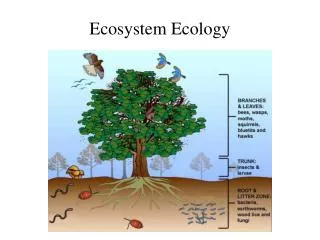
Ecosystem Ecology Examines Interactions Between the Living and Non-Living World • Ecosystem – a particular location on Earth distinguished by its particular mix of interacting biotic and abiotic components
Ecosystem Boundaries • Some ecosystems, such as a caves and lakes have very distinctive boundaries • However, in most ecosystems it is difficult to determine where one ecosystems stops and the next begins
Ecosystem Processes • Even though it is helpful to distinguish between two different ecosystems, ecosystems interact with other ecosystems
Photosynthesis and Respiration • Producers (autotrophs) are able to use the sun’s energy to produce usable energy through the process called photosynthesis
Photosynthesis and Respiration • Cellular respiration is the process by which other organisms gain energy from eating the tissues of producers
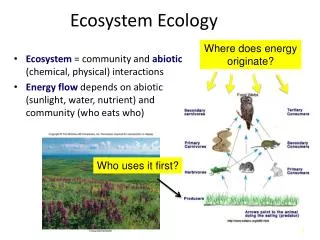
Trophic Levels, Food Chains, and Food Webs • Consumers (heterotrophs) – obtain energy by consuming other organisms • Primary Consumers (herbivores) – consume producers • Secondary Consumers (carnivores) – obtain their energy by eating primary consumers • Tertiary Consumers (carnivores) – eat secondary consumers
Consumers (heterotrophs) • scavengers: feed on dead organisms
Consumers (heterotrophs) • detritivores: feed on detritus (partially decomposed organic matter, such as leaf litter & animal dung) and breakdown this organic material into smaller particles
Consumers (heterotrophs) • decomposers: consumers that complete the “circle of life” by digesting organic materials into smaller molecules
Food Chains • Food chain – the sequence of consumption from producers through tertiary consumers
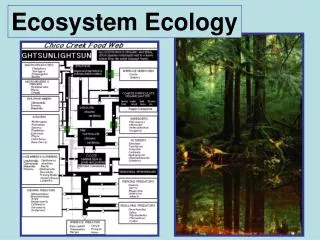
Food Web • Food web – a more realistic type of food chain that takes into account the complexity of nature
Ecosystem Productivity • Gross primary productivity (GPP) – the total amount of solar energy that the producers in an ecosystem capture via photosynthesis over a given amount of time • Net primary productivity (NPP) – the energy captured (GPP) minus the energy respired by producers • NPP = GPP – energy used by producers • Measured in kg C/m2/year
What do you think? • Why do food chains rarely have more than 4 or 5 trophic levels?
Food Chains • Which are more numerous in an ecosystem: producers or consumers? • Producers are always more numerous than consumers, why?
Energy Loss • Of the energy that an organism consumes, only a small fraction (ecological efficiency of about 10%) is transferred to the next trophic level
Where does that energy go? • Most of the energy is lost as heat