Unveiling the Bacterial World: Classification, Evolution, and Survival Tactics
Explore the vast world of bacteria, from their classification methods to genetic recombination processes. Discover the evolution of eubacteria and archaebacteria, the differences between Gram-positive and Gram-negative bacteria, and the fascinating extremophiles among them. Learn about Methanogens, Halophiles, Acidophiles, and Cyanobacteria, as well as the importance of genetic recombination in bacterial survival strategies.

Unveiling the Bacterial World: Classification, Evolution, and Survival Tactics
E N D
Presentation Transcript
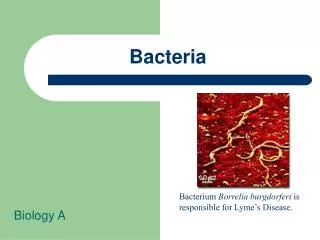
Bacteria “bacteria by Jonathan Coulton
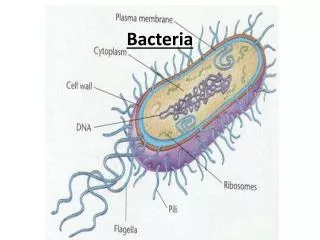
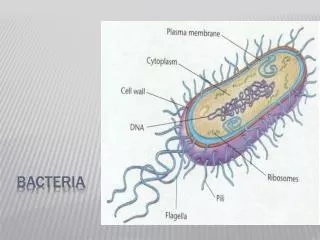
Objectives • Define Bacteria, eubacteria, & archaebacteria, and note the relationships between them. • Methods used to classify bacteria • Describe 3 types of archaebacteria • Gram-positive vs. Gram-negative bacteria • Structure of a bacteria cell • How they move • Bacterial genetic recombination
It’s their planet, they were here first, and there’s more of them than us. • They’re microscopic prokaryotes • No nucleus, ect… The bacteria save us in War of the Worlds
Evolution • They’ve been evolving for 3.5 billion years, that’s a lot of time to turn into different species. • They’ve found ways to survive almost everywhere. Some can “hibernate” in space • Leads to interesting ideas
How many? • 40 million bacteria in a gram of dirt • 1 million in a mL of fresh water • 5x1030 bacteria in the world • Your body has 10x’s more bacteria cells than human cells in it
Classification • A lot of bacteria look pretty much alike • Group them on… • Structure, physiology, how they react to dif. Types of staining techniques • OR group them on RNA similarity
Why did the bacteria cross the microscope? • To get to the other slide.
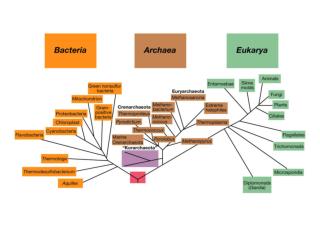
Two kinds of bacteria • Eubacteria • Archaebacteria • More ancient group
Archaebacteria • Have weird lipids on their membranes • Have introns in their DNA • Have NO Peptidoglycan • A protein/carb mix
Extremophiles • Love extremes • No competition there • Places to salty, acidic, hot or cold, for life
Methanogens • Oxygen kills them • Live at bottom of swamps, or in sewage • Can combine O2 and CO2 into methane • Swamp gas • And in your gut • Enteric bacteria • E. Coli a facultative anaerobe: It can live with or without O2 • Obligate anaerobes: Have to live where there’s no O2
Halophiles & Acidophiles • Halophiles: Love salt • Live in the dead sea • 2nd saltiest water on Earth • 8x’s saltier than oceans • Lowest point on earth not covered by ice • 418 M below sea level
Dead Sea • King David, Herod, Jesus, John The Baptist, • Jericho is just north (oldest continually occupied town • But the sea is shrinking • People need water
Volcanic acid lake in Gorley (Kamchatka, Russia) • A crowbar will dissolve in about an hour in this lake
Acid Lake in Taal, Phillipines • Sulfuric vents at the lake’s edge
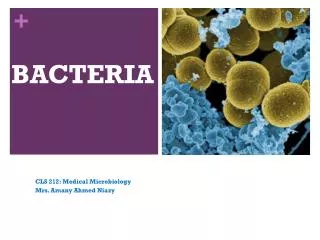
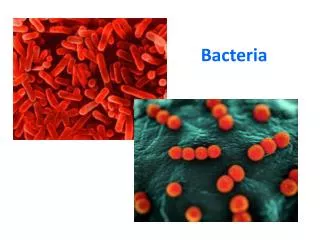
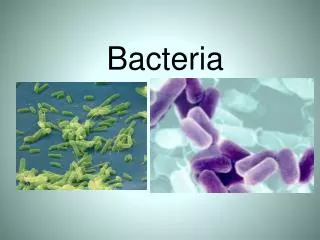
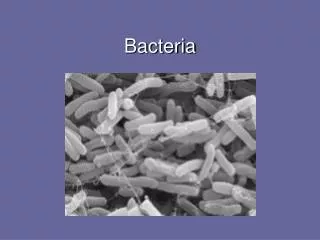
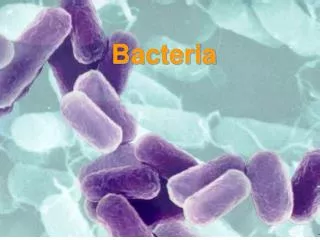
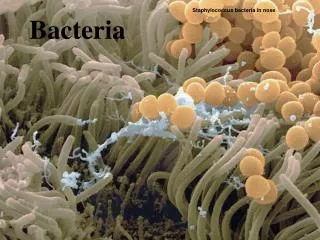
Eubacteria • Rod shaped: Bacilli • Sphere shaped: cocci • Linked in a chain: streptococci • Grape-like clusters: staphylococci • Spiral shpaed: Spirilla
Gram Stain • Gram-positive: keep the stain, show up purple • They have peptidoglycan • These bacteria make yogurt • Gram-negative: don’t take the gram stain, but do take a pink stain instead • Rhizobium: makes N2 gases usable by plants • The difference: Make dif, chemicals, react to dif antibiotics and disinfectants
Cyanobacteria • Not plants, but do photosynthesis • Heterocysts: a kind that makes Nitrogen usable for plants • If you put a lot of nitrogen into a water supply you get a population bloom • Eutrophication: all these bacteria suck up the oxygen and everything else in the water dies
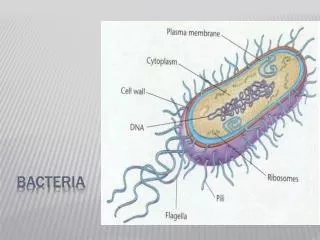
Genetic recombination • Without reproducing bacteria can acquire and express new genetic info • Transformation: Bacteria take in DNA around it • Conjugation: Bacteria use pilli to make a bridge between each other and uses plasmids • Transduction: viruses carry DNA between bacteria