Particle Flow Algorithm Performance in GLD for ILC: Photon and Hadron Reconstructive Studies
This presentation focuses on the Particle Flow Algorithm (PFA) utilized in the GLD design for the International Linear Collider (ILC). The study emphasizes the importance of jet energy resolution, achieved through precise tracking of charged particles, photons, and neutral hadrons. The report covers methodologies for photon likelihood and hadron finding, showcasing event displays from the Z → qqbar process at 91.2 GeV. Particular attention is paid to performance metrics, including energy-weighted efficiency and purity, alongside the impact of varying energy levels on jet resolution.

Particle Flow Algorithm Performance in GLD for ILC: Photon and Hadron Reconstructive Studies
E N D
Presentation Transcript
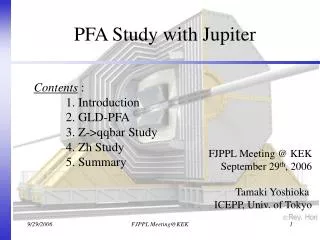
PFA Study with Jupiter Contents : 1. Introduction 2. GLD-PFA 3. Z->qqbar Study 4. Zh Study 5. Summary FJPPL Meeting @ KEK September 29th, 2006 Tamaki Yoshioka ICEPP, Univ. of Tokyo FJPPL Meeting@KEK
Introduction • Most of the important physics processes to be studied in the ILC • experiment have multi-jets in the final state. • → Jet energy resolution is the key in the ILC physics. • The best energy resolution is obtained by reconstructing • momenta of individual particles avoiding double counting among • Trackers and Calorimeters. • - Charged particles (~60%) measured by Tracker. • - Photons (~30%) by electromagnetic CAL (ECAL). • - Neutral hadrons (~10%) by ECAL + hadron CAL (HCAL). • → Particle Flow Algorithm (PFA) • In this talk, general scheme and performance of the GLD-PFA, • using the GEANT4-based full simulator (Jupiter),will be presented. FJPPL Meeting@KEK
Geometry in Jupiter Solenoid TPC Hadron Calorimeter (HCAL) VTX, IT Muon Detector Electromagnetic Calorimeter (ECAL) Dodecagonal Shape As of August 06 FJPPL Meeting@KEK
Calorimeter Geometry in Jupiter Readout Line =10cm 349.4cm BarrelHD 229.8cm BarrelEM 210cm 270cm EndcapHD Barrel.InnerRadius=210cm EndcapEM Endcap.InnerRadius=40cm IP Barrel.HalfZ=280cm 419.4cm 280cm 299.8cm FJPPL Meeting@KEK
Calorimeter Structure Active Layer Absorber Current cell size : 2x2cm Can be changed. ECAL W/Scinti./Gap 3/2/1 (mm) x 33 layers HCAL Fe/Scinti./Gap 20/5/1 (mm) x 46 layers FJPPL Meeting@KEK
GLD-PFA FJPPL Meeting@KEK
Particle Flow Algorithm for GLD Flow of GLD-PFA • Photon Finding • Charged Hadron Finding • Neutral Hadron Finding • Satellite Hits Finding • *Satellite hits = calorimeter hit cell which does not belong • to a cluster core Note : Monte-Carlo truth information is used for muon and neutrino. FJPPL Meeting@KEK
Photon Likelihood (Input) - Five variables are selected to form the photon likelihood function. velocity meanlay trkdis chi2 Edep/nhits Photon Other FJPPL Meeting@KEK
Photon Likelihood (Output) linear • Cut position is set • to be 0.7. Other Photon log Photon Other FJPPL Meeting@KEK
Charged Hadron Finding • Basic Concept : • Extrapolate the charged track and calculate a distance between • a calorimeter hit cell and the extrapolated track. Connect the cell • that in a certain tube radius (clustering). Extrapolated Track • Calculate the distance • for any track/calorimeter • cell combination. HCAL Tube Radius Hit Cells • Tube radius for ECAL • and HCAL can be changed • separately. distance ECAL Calorimeter input position Charged Track FJPPL Meeting@KEK
Neutral Hadron Likelihood (Input) - Four variables are selected to form the NHD likelihood function. velocity Edensity Edep/nhits meanlayer Neutral Hadron Satellite Hits FJPPL Meeting@KEK
Neutral Hadron Likelihood (Output) linear Neutral Hadron Satellite Hits • Cut position is set • to be 0.73. log Neutral Hadron Satellite Hits FJPPL Meeting@KEK
Z -> qqbar FJPPL Meeting@KEK
Z-pole Event Display End View Side View - 2cm x 2cm tile (GLD backup solution) is used in this study. FJPPL Meeting@KEK
e+ e- Yellow : Photon Red,Green : Charged Hadron Black,Blue : Neutral Hadron Z → qqbar @ 91.2GeV Event Display FJPPL Meeting@KEK Next: 電子、陽電子衝突
Event Display Yellow : Photon Red,Green : Charged Hadron Black,Blue : Neutral Hadron Gamma Finding FJPPL Meeting@KEK
Event Display Yellow : Photon Red,Green : Charged Hadron Black,Blue : Neutral Hadron Charged Hadron Finding FJPPL Meeting@KEK
Event Display Yellow : Photon Red,Green : Charged Hadron Black,Blue : Neutral Hadron Satellite Hits Finding FJPPL Meeting@KEK
Event Display Yellow : Photon Red,Green : Charged Hadron Black,Blue : Neutral Hadron Remaining : Neutral Hadron FJPPL Meeting@KEK
Performance - Energy-weighted Efficiency and Purity Definition Efficiency : xxx (total xx E in collected hits)/(true xxx total E in CAL) Purity : Pxxx (total xxx E in a cluster)/(total E in a cluster) xxx = Photon, CHD, NHD, Satellite both and P values are energy-weighted FJPPL Meeting@KEK
All angle • In barrel region, ILC goal of 30% has been achieved. • Performance in 0.7<|cosθ|<0.8 is too bad. → Already fixed. Jet Energy Resolution - Z → uds @ 91.2GeV, new calorimeter geometry, 2cm x 2cm tile FJPPL Meeting@KEK
Energy Dependence - Energy dependence of jet energy resolution. • Bad performance for higher energy. • Not so bad performance for < 100 GeV Jet. FJPPL Meeting@KEK
Linearity - Good linearity. Jet energy can be corrected. FJPPL Meeting@KEK
Zh →nn h First look at the Zh events with Jupiter and realistic PFA. FJPPL Meeting@KEK
Typical Event Display • Two jets from Higgs can be seen. FJPPL Meeting@KEK
Zh → nn h @ 350GeV - Fast MC • w/o correction • w/ correction Higgs Mass Visible Energy • - Jet energy is corrected by an empirical • formula obtained by Z → qqbar studies. • - Selection Criteria • 90 < Evis < 200 GeV • pt >20 GeV/c Missing Mass FJPPL Meeting@KEK
Kinematical Fit • - 6 Measured Variables • Jet1 : Ej1, qj1, jj1 • Jet2 : Ej2, qj2, jj2 (Note : Ej1 >Ej2) • - 3 Unmeasured Variables • Z0 : Ez, qz, jz • 4 Constraints • pj1cosjj1sinqj1 + pj2cosjj2sinqj2 + pZcosjZsinqZ = 0 • pj1sinjj1sinqj1 + pj2sinjj2sinqj2 + pZsinjZsinqZ = 0 • pj1cosqj1 + pj2cosqj2 + pZcosqZ = 0 • Ej1 + Ej2 + Ez – Ecm = 0 • (Note: jet mass is fixed : pfit = √{Efit2– (Emeas2 – pmeas2)} ) • → 1C-fit can be performed. FJPPL Meeting@KEK
Fitted Results Prob > 0.02 Very Preliminary • Higgs mass resolution is significantly improved. … But, • Peak at prob=1 indicates the fitting didn’t work well. FJPPL Meeting@KEK
Stretch Functions • The stretch function should form a normal Gaussian if the X and • s are proper. Too Narrow = Overestimated Strange Need to understand. FJPPL Meeting@KEK
Summary • Realistic PFA has been developed using the GEANT-4 based full simulator of the GLD detector. • Jet energy resolution is studied by using Z->qq events. ILC goal of 30% has been achieved for Z-pole events. • ZH study based on current PFA performance is now ongoing. FJPPL Meeting@KEK