CSE544 Query Optimization
This document discusses cost-based optimization strategies for query execution plans in database systems, as presented by Dan Suciu during Winter 2011. It outlines the process of enumerating alternative plans, computing their estimated costs—including I/O and CPU costs—and selecting the plan with the lowest cost. The document further illustrates these concepts with practical examples involving SQL queries, statistics about data tables, and physical query plans. Key lessons include the importance of various physical plans and the need for statistical data to enhance optimization decisions.

CSE544 Query Optimization
E N D
Presentation Transcript
CSE544Query Optimization Tuesday-Thursday, February 8th-10th, 2011 Dan Suciu -- 544, Winter 2011
Outline • Chapter 15 in the textbook Dan Suciu -- 544, Winter 2011
Query Optimization Algorithm • Enumerate alternative plans • Compute estimated cost of each plan • Compute number of I/Os • Compute CPU cost • Choose plan with lowest cost • This is called cost-based optimization Dan Suciu -- 544, Winter 2011
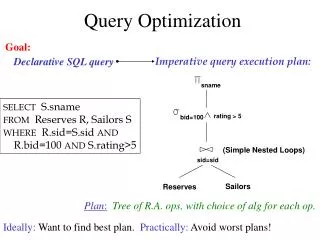
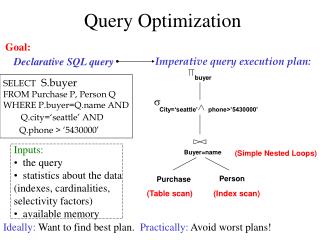
Example SELECT sname FROM Supplier x, Supply y WHERE x.sid = y.sid and y.pno = 2 and x.scity = ‘Seattle’ and x.sstate = ‘WA’ Supplier(sid, sname, scity, sstate) Supply(sid, pno, quantity) • Some statistics • T(Supplier) = 1000 records • T(Supply) = 10,000 records • B(Supplier) = 100 pages • B(Supply) = 100 pages • V(Supplier,scity) = 20, V(Supplier,state) = 10 • V(Supply,pno) = 2,500 • Both relations are clustered • M = 10 Dan Suciu -- 544, Winter 2011
T(Supplier) = 1000 T(Supply) = 10,000 B(Supplier) = 100 B(Supply) = 100 V(Supplier,scity) = 20 V(Supplier,state) = 10 V(Supply,pno) = 2,500 M = 10 Physical Query Plan 1 (On the fly) sname (On the fly) scity=‘Seattle’ sstate=‘WA’ pno=2 (Block-nested loop) sid = sid Supplier Supply (File scan) (File scan) Dan Suciu -- 544, Winter 2011
T(Supplier) = 1000 T(Supply) = 10,000 B(Supplier) = 100 B(Supply) = 100 V(Supplier,scity) = 20 V(Supplier,state) = 10 V(Supply,pno) = 2,500 M = 10 Physical Query Plan 1 (On the fly) sname Selection and project on-the-fly -> No additional cost. Total cost of plan is thus cost of join: = B(Supplier)+B(Supplier)*B(Supply)/M = 100 + 10 * 100 = 1,100 I/Os (On the fly) scity=‘Seattle’ sstate=‘WA’ pno=2 (Block-nested loop) sid = sid Supplier Supply (File scan) (File scan) Dan Suciu -- 544, Winter 2011
T(Supplier) = 1000 T(Supply) = 10,000 B(Supplier) = 100 B(Supply) = 100 V(Supplier,scity) = 20 V(Supplier,state) = 10 V(Supply,pno) = 2,500 M = 10 Physical Query Plan 2 sname (On the fly) (Sort-merge join) sid = sid (Scan write to T1) (Scan write to T2) scity=‘Seattle’ sstate=‘WA’ pno=2 Supplier Supply (File scan) (File scan) Dan Suciu -- 544, Winter 2011
T(Supplier) = 1000 T(Supply) = 10,000 B(Supplier) = 100 B(Supply) = 100 V(Supplier,scity) = 20 V(Supplier,state) = 10 V(Supply,pno) = 2,500 M = 10 Physical Query Plan 2 Total cost = 100 + 100 * 1/20 * 1/10 (1) + 100 + 100 * 1/2500 (2) + 2 (3) + 0 (4) Total cost 204 I/Os sname (On the fly) (Sort-merge join) sid = sid (Scan write to T1) (Scan write to T2) scity=‘Seattle’ sstate=‘WA’ pno=2 Supplier Supply (File scan) (File scan) Dan Suciu -- 544, Winter 2011
T(Supplier) = 1000 T(Supply) = 10,000 B(Supplier) = 100 B(Supply) = 100 V(Supplier,scity) = 20 V(Supplier,state) = 10 V(Supply,pno) = 2,500 M = 10 Physical Query Plan 3 (On the fly) sname (On the fly) scity=‘Seattle’ sstate=‘WA’ (Index nested loop) sid = sid (Use index) pno=2 Supplier Supply (Index lookup on pno) Assume: clustered (Index lookup on sid) Doesn’t matter if clustered or not
T(Supplier) = 1000 T(Supply) = 10,000 B(Supplier) = 100 B(Supply) = 100 V(Supplier,scity) = 20 V(Supplier,state) = 10 V(Supply,pno) = 2,500 M = 10 Physical Query Plan 3 (On the fly) sname (On the fly) scity=‘Seattle’ sstate=‘WA’ (Index nested loop) sid = sid 4 tuples (Use index) pno=2 Supplier Supply (Index lookup on pno) Assume: clustered (Index lookup on sid) Doesn’t matter if clustered or not
T(Supplier) = 1000 T(Supply) = 10,000 B(Supplier) = 100 B(Supply) = 100 V(Supplier,scity) = 20 V(Supplier,state) = 10 V(Supply,pno) = 2,500 M = 10 Physical Query Plan 3 (On the fly) sname Total cost = 1 (1) + 4 (2) + 0 (3) + 0 (3) Total cost 5 I/Os (On the fly) scity=‘Seattle’ sstate=‘WA’ (Index nested loop) sid = sid 4 tuples (Use index) pno=2 Supplier Supply (Index lookup on pno) Assume: clustered (Index lookup on sid) Doesn’t matter if clustered or not
Simplifications • In the previous examples, we assumed that all index pages were in memory • When this is not the case, we need to add the cost of fetching index pages from disk Dan Suciu -- 544, Winter 2011
Lessons • Need to consider several physical plan • even for one, simple logical plan • No plan is best in general • need to have statistics over the data • the B’s, the T’s, the V’s Dan Suciu -- 544, Winter 2011
The Contract of the Optimizer • High-quality execution plans for all queries, • While taking relatively small optimization time, and • With limited additional input such as histograms. Dan Suciu -- 544, Winter 2011
Query Optimization Three major components: • Search space • Algorithm for enumerating query plans • Cardinality and cost estimation Dan Suciu -- 544, Winter 2011
History of Query Optimization • First query optimizer was for System R, from IBM, in 1979 • It had all three components in place, and defined the architecture of query optimizers for years to come • You will see often references to System R • Read Section 15.6 in the book Dan Suciu -- 544, Winter 2011
1. Search Space • This is the set of all alternative plans that are considered by the optimizer • Defined by the set of algebraic laws and the set of plans used by the optimizer • Will discuss these laws next Dan Suciu -- 544, Winter 2011
Left-Deep Plans andBushy Plans R2 R4 R3 R1 R3 R1 R2 R4 Left-deep plan Bushy plan System R considered only left deep plans, and so do some optimizers today Dan Suciu -- 544, Winter 2011
Relational Algebra Laws • Selections • Commutative: c1(c2(R)) = c2(c1(R)) • Cascading: c1c2(R) = c2(c1(R)) • Projections • Joins • Commutativity: R ⋈ S = S⋈ R • Associativity: R ⋈ (S⋈ T) = (R ⋈ S)⋈ T • Distributivity: R ⨝ (S T) = (R ⨝ S) (R ⨝ T) • Outer joins get more complicated Dan Suciu -- 544, Winter 2011
Example • Which plan is more efficient ? • R ⨝ (S ⨝ T) or (R ⨝ S) ⨝ T ? • Assumptions: • Every join selectivity is 10% • That is: T(R ⨝ S) = 0.1 * T(R) * T(S) etc. • B(R)=100, B(S) = 50, B(T)=500 • All joins are main memory joins • All intermediate results are materialized Dan Suciu -- 544, Winter 2011
Example • Example: R(A, B, C, D), S(E, F, G) sF=3 (R ⨝D=E S) = ? sA=5 AND G=9 (R ⨝D=E S) = ? Dan Suciu -- 544, Winter 2011
Simple Laws • Example R(A,B,C,D), S(E, F, G) PA,B,G(R ⨝D=E S) = P ? (P?(R) ⨝D=EP?(S)) PM(R ⨝ S) = PM(PP(R) ⨝ PQ(S)) PM(PN(R)) = PM(R) /* note that M ⊆ N */ Dan Suciu -- 544, Winter 2011
Laws for Group-by and Join A, agg(D)(R(A,B) ⨝B=C S(C,D)) = A, agg(D)(R(A,B) ⨝B=C (C, agg(D)S(C,D))) These are very powerful laws. They were introduced only in the 90’s. Dan Suciu -- 544, Winter 2011
“Semantic Optimizations” = Laws that use a Constraint Foreign key Product(pid, pname, price, cid)Company(cid, cname, city, state) Ppid, price(Product ⨝cid=cid Company) = Ppid, price(Product) Need a second constraint for this law to hold. Which ? Dan Suciu -- 544, Winter 2011
Example Foreign key Product(pid, pname, price, cid)Company(cid, cname, city, state) CREATE VIEWCheapProductCompany SELECT * FROM Product x, Company yWHEREx.cid = y.cid and x.price < 100 SELECTpname, priceFROMCheapProductCompany SELECTpname, priceFROM Product Dan Suciu -- 544, Winter 2011
Law of Semijoins Recall the definition of a semijoin: • R ⋉ S = PA1,…,An (R ⨝ S) • Where the schemas are: • Input: R(A1,…An), S(B1,…,Bm) • Output: T(A1,…,An) • The law of semijoins is: R ⨝ S = (R ⋉ S) ⨝ S Dan Suciu -- 544, Winter 2011
Laws with Semijoins • Very important in parallel databases • Often combined with Bloom Filters (next lecture) • Read pp. 747 in the textbook Dan Suciu -- 544, Winter 2011
Semijoin Reducer • Given a query: • A semijoin reducer for Q is such that the query is equivalent to: • A full reducer is such that no dangling tuples remain Q = R1 ⨝ R2⨝ . . . ⨝Rn Ri1 = Ri1⋉ Rj1 Ri2 = Ri2⋉ Rj2 . . . . . Rip = Rip⋉Rjp Q = Rk1 ⨝ Rk2⨝ . . . ⨝Rkn Dan Suciu -- 544, Winter 2011
Example • Example: • Asemijoin reducer is: • The rewritten query is: Q = R(A,B) ⨝ S(B,C) R1(A,B) = R(A,B) ⋉ S(B,C) Q = R1(A,B) ⨝ S(B,C)
Why Would We Do This ? • Large attributes: • Expensive side computations Q = R(A, B, D, E, F,…) ⨝ S(B, C, M, K, L, …) Q = γA,B,count(*)R(A,B,D) ⨝ σC=value(S(B,C)) R1(A,B,D) = R(A,B,D) ⋉ σC=value(S(B,C)) Q = γA,B,count(*)R1(A,B,D) ⨝ σC=value(S(B,C))
Semijoin Reducer • Example: • Asemijoin reducer is: • The rewritten query is: Q = R(A,B) ⨝ S(B,C) R1(A,B) = R(A,B) ⋉ S(B,C) Q = R1(A,B) ⨝ S(B,C) Are there dangling tuples ?
Semijoin Reducer • Example: • A full semijoin reducer is: • The rewritten query is: Q = R(A,B) ⨝ S(B,C) R1(A,B) = R(A,B) ⋉ S(B,C)S1(B,C) = S(B,C) ⋉ R1(A,B) Q :- R1(A,B) ⨝ S1 (B,C) No more dangling tuples
Semijoin Reducer • More complex example: • A full reducer is: Q = R(A,B) ⨝ S(B,C) ⨝ T(C,D,E) S’(B,C) := S(B,C) ⋉R(A,B) T’(C,D,E) := T(C,D,E) ⋉ S(B,C) S’’(B,C) := S’(B,C) ⋉ T’(C,D,E) R’(A,B) := R(A,B) ⋉ S’’(B,C) Q = R’(A,B) ⨝ S’’(B,C) ⨝ T’(C,D,E)
Semijoin Reducer • Example: • Doesn’t have a full reducer (we can reduce forever) Theorem a query has a full reducer iff it is “acyclic” [Database Theory, by Abiteboul, Hull, Vianu] Q = R(A,B) ⨝ S(B,C) ⨝ T(A,C) Dan Suciu -- 544, Winter 2011
Example with Semijoins Emp(eid, ename, sal, did)Dept(did, dname, budget) DeptAvgSal(did, avgsal) /* view */ [Chaudhuri’98] View: CREATE VIEWDepAvgSal As ( SELECT E.did, Avg(E.Sal) AS avgsal FROM Emp E GROUP BY E.did) Query: SELECT E.eid, E.sal FROM Emp E, Dept D, DepAvgSal V WHERE E.did = D.did AND E.did = V.did AND E.age < 30 AND D.budget > 100k AND E.sal > V.avgsal Goal: compute only the necessary part of the view
Example with Semijoins Emp(eid, ename, sal, did)Dept(did, dname, budget) DeptAvgSal(did, avgsal) /* view */ [Chaudhuri’98] CREATE VIEWLimitedAvgSalAs ( SELECT E.did, Avg(E.Sal) AS avgsal FROM Emp E, Dept DWHERE E.did = D.did AND D.buget > 100k GROUPBY E.did) New viewuses a reducer: SELECT E.eid, E.sal FROM Emp E, Dept D, LimitedAvgSal V WHERE E.did = D.did AND E.did = V.did AND E.age < 30 AND D.budget > 100k AND E.sal > V.avgsal New query:
Example with Semijoins Emp(eid, ename, sal, did)Dept(did, dname, budget) DeptAvgSal(did, avgsal) /* view */ [Chaudhuri’98] CREATE VIEW PartialResult AS (SELECT E.eid, E.sal, E.did FROM Emp E, Dept D WHERE E.did=D.did AND E.age < 30 AND D.budget > 100k) CREATEVIEW Filter AS (SELECTDISTINCT P.did FROM PartialResult P) CREATEVIEW LimitedAvgSal AS (SELECT E.did, Avg(E.Sal) AS avgsal FROM Emp E, Filter F WHERE E.did = F.did GROUPBY E.did) Full reducer:
Example with Semijoins New query: SELECT P.eid, P.sal FROM PartialResult P, LimitedDepAvgSal V WHERE P.did = V.did AND P.sal > V.avgsal Dan Suciu -- 544, Winter 2011
Pruning the Search Space • Prune entire sets of plans that are unpromising • The choice of partial plans influences how effective we can prune Dan Suciu -- 544, Winter 2011
Complete Plans R(A,B)S(B,C)T(C,D) SELECT * FROM R, S, T WHERE R.B=S.B and S.C=T.C and R.A<40 ⨝ ⨝ Pruning isdifficulthere. ⨝ T σA<40 ⨝ σA<40 S R S T R Dan Suciu -- 544, Winter 2011
Bottom-up Partial Plans R(A,B)S(B,C)T(C,D) SELECT * FROM R, S, T WHERE R.B=S.B and S.C=T.C and R.A<40 ⨝ Pruning can be donemore efficiently ⨝ ⨝ T σA<40 ⨝ ⨝ σA<40 S σA<40 S ….. R S T R R S R
Top-down Partial Plans R(A,B)S(B,C)T(C,D) SELECT * FROM R, S, T WHERE R.B=S.B and S.C=T.C and R.A<40 ⨝ ⨝ σA<40 ⨝ T T SELECT R.A, T.D FROM R, S, T WHERE R.B=S.B and S.C=T.C SELECT * FROM R, S WHERE R.B=S.B and R.A < 40 ….. S SELECT * FROM R WHERE R.A < 40
Query Optimization Three major components: • Search space • Algorithm for enumerating query plans • Cardinality and cost estimation Dan Suciu -- 544, Winter 2011
2. Plan Enumeration Algorithms • System R (in class) • Join reordering– dynamic programming • Access path selection • Bottom-up; simple; limited • Modern database optimizers (will not discuss) • Rule-based: database of rules (x 100s) • Dynamic programming • Top-down; complex; extensible Dan Suciu -- 544, Winter 2011
Join Reordering System R [1979] • Push all selections down (=early) in the query plan • Pull all projections up (=late) in the query plan • What remains are joins: SELECT listFROM R1, …, RnWHERE cond1 AND cond2 AND . . . AND condk Dan Suciu -- 544, Winter 2011
SELECT listFROM R1, …, RnWHERE cond1 AND cond2 AND . . . AND condk Join Reordering Dynamic programming • For each subquery Q {R1, …, Rn},compute the optimal join order for Q • Store results in a table: 2n-1 entries • Often much fewer entries Dan Suciu -- 544, Winter 2011
SELECT listFROM R1, …, RnWHERE cond1 AND cond2 AND . . . AND condk Join Reordering Step 1: For each {Ri} do: • Initialize the table entry for {Ri} with the cheapest access path for Ri Step 2: For each subset Q {R1, …, Rn} do: • For every partition Q = Q’ Q’’ • Lookup optimal plan for Q’ and for Q’’ in the table • Compute the cost of the plan Q’ ⨝ Q’’ • Store the cheapest plan Q’ ⨝ Q’’ in table entry for Q Dan Suciu -- 544, Winter 2011
Reducing the Search Space Restriction 1: only left linear trees (no bushy) Restriction 2: no trees with cartesian product R(A,B) ⨝ S(B,C) ⨝ T(C,D) Plan: (R(A,B)⨝T(C,D)) ⨝ S(B,C)has a cartesian product. Most query optimizers will not consider it Dan Suciu -- 544, Winter 2011
Access Path Selection • Access path: a way to retrieve tuples from a table • A file scan • An index plus a matching selection condition • Index matches selection condition if it can be used to retrieve just tuples that satisfy the condition • Example: Supplier(sid,sname,scity,sstate) • B+-tree index on (scity,sstate) • matches scity=‘Seattle’ • does not match sid=3, does not match sstate=‘WA’ Dan Suciu -- 544, Winter 2011
Access Path Selection • Supplier(sid,sname,scity,sstate) • Selection condition: sid > 300 scity=‘Seattle’ • Indexes: B+-tree on sidand B+-tree on scity Dan Suciu -- 544, Winter 2011