Understanding Friction: Principles and Factors Affecting Motion
Friction is a force that opposes motion, influenced by the contact surfaces of objects. Rough surfaces generally exhibit different frictional properties compared to smooth surfaces, and understanding these differences is essential. The frictional force is not dependent on surface area but rather on the types of materials in contact through microscopic interactions. Key concepts include static and kinetic friction coefficients, their impact on traction, and factors affecting vehicle traction like weight and road conditions. Learn how friction determines motion and affects our daily activities.

Understanding Friction: Principles and Factors Affecting Motion
E N D
Presentation Transcript
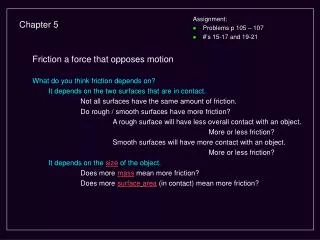
Assignment: • Problems p 105 – 107 • #’s 15-17 and 19-21 Friction a force that opposes motion What do you think friction depends on? It depends on the two surfaces that are in contact. Not all surfaces have the same amount of friction. Do rough / smooth surfaces have more friction? A rough surface will have less overall contact with an object. More or less friction? Smooth surfaces will have more contact with an object. More or less friction? It depends on the size of the object. Does more mass mean more friction? Does more surfacearea (in contact) mean more friction? Chapter 5
Friction... • Friction is caused by the “microscopic” interactions between the two surfaces. Your book refers to it as “electromagnetic bonding”
Friction is not dependant of surface area in contact, or surface smoothness. Friction depends on the two types of surfaces in contact. “Sticky” surfaces “slippery” surfaces rubber tire and asphalt rubber tire and wet asphalt rubber and wooden flooring leather (shoes) and wooden flooring glass and glass paper and a desktop FRICTONAL COEFFICIENT ( µ ) (mu, “mew” 12th character of the ancient Greek alphabet) A number (coefficient) that is given to two materials that helps determine the frictional force between them. µ will always be less than 1 (one) for us in this class. (sticky surfaces can be more than 1)
friction • How does it work? It opposes motion. It always acts parallel to the surface. It cannot cause motion! usingFREE BODY DIAGRAMS to show forces N F applied F friction mg
FREE BODY DIAGRAMSVector arrows are used to represent forces. What force is going to cancel the weight? NORMAL FORCE F applied F friction m Weight (mg) NORMAL FORCE IS THE FORCE OF A SURFACE ON AN OBJECT. IT IS ALWAYS DIRECTED PERPENDICULAR TO THE SURFACE.
What if Fapplied is larger than the frictional force? The resulting force causes an acceleration. F normal F applied Fnet = Fa - f Fnet = ma F friction m Weight (mg)
Remember Newton’s first law (inertia) and the level of force needed to move a refrigerator; Once you get it moving, it is easy to keep moving. Why is that? PHYSICS! Ugh!
Sliding Friction The constant K is called the “coefficient of kinetic friction” µK is discovered by pulling with a constant Fapplied as the object slides at a constant speed. Fapplied – µkinetic (Fnormal) = ma if: ma = 0 (no acceleration) then: Fapplied = µkinetic (Fnormal) or: µkinetic = Fapplied / Fnormal
Static Friction... The constant µS is called the “coefficient of static friction” µS is discovered by increasing Fapplied until the block is at the brink of starting to slide. Fapplied – µstatic (Fnormal) = ma if: ma = 0(no motion)then: Fapplied = µstatic (Fnormal) or: µstatic = Fapplied / Fnormal
Some coefficients of friction static friction kinetic friction s k Material on Material steel / steel 0.6 0.4 add grease to steel 0.1 0.05 metal / ice 0.022 0.02 brake lining / iron 0.4 0.3 tire / dry pavement 0.9 0.8 tire / wet pavement 0.8 0.7
It takes nearly 25% longer to stop on wet asphalt as dry four times longer to stop on dirt road as dry asphalt. Wet snow is almost impossible to start, stop or turn a vehicle on (inertia) Coefficient of friction – A. Dry asphalt is .78 – B. Wet asphalt is .60 – C. Dirt road is .20 – D. Dry snow is .20 – E. Wet snow is .10 Types of Traction There are three types of traction. Each are to overcome inertia. (rest, motion, straight line) – A. Acceleration traction – B. Braking traction – C. Cornering traction Things That Can Affect Traction. A.. Tires - Type, Wear, Inflation B.. Road Surface - Asphalt., Concrete, Gravel, Dirt C.. Condition of road – Surface, Rain, Snow, Ice More Factors that affect Traction: Weight of vehicle Type of vehicle Bank of road/curve Speed of vehicle Driver response Temperature of road/tires More on friction :Friction between road and tires is traction or adhesion