Analyzing W-CDMA Signal Data from TSW1400 and TSW1266 Evaluation Modules
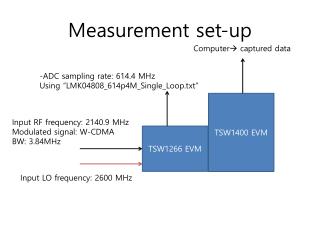
This document addresses the setup and analysis of data captured from a W-CDMA modulated signal using TSW1400 EVM and TSW1266 EVM. The ADC sampling rate utilized is 614.4 MHz, and the input RF frequency is 2140.9 MHz with a bandwidth of 3.84 MHz. Questions arise about analyzing the output signals on HSDCPro GUI, specifically regarding “I” and “Q” signal representations and their corresponding data integrity. The document seeks clarity on whether the received data is correct and if the demodulator functions as intended.

Analyzing W-CDMA Signal Data from TSW1400 and TSW1266 Evaluation Modules
E N D
Presentation Transcript
Measurement set-up Computer captured data -ADC sampling rate: 614.4 MHz Using “LMK04808_614p4M_Single_Loop.txt” TSW1400 EVM Input RF frequency: 2140.9 MHz Modulated signal: W-CDMA BW: 3.84MHz TSW1266 EVM Input LO frequency: 2600 MHz
question In HSDCpro GUI, Channel 1 = “I signal” ?? Channel 2 = “Q signal” ?? Am I wrong? RF LO TSW1266 EVM data sheet
ADS5401-09 I checked channel 1 and channel 2.
ADS5401-09 I checked channel 1 and channel 2.
ADC code ADC code sample Red: channel 1 data Blue: channel 2 data sample • Plot data(channel1, channel2) • Channel 1 and channel 2 is same. • Am I wrong to get data from HSDCpro? • Does demodulator operate correctly ?