Understanding Hydrocarbons and Functional Groups in Organic Chemistry
This overview dives into hydrocarbons, the building blocks of organic molecules consisting of carbon and hydrogen. It introduces isomers—molecules with the same formula but different structures—alongside various hydrocarbon series: alkanes (CnH2n+2, saturated), alkenes (CnH2n, unsaturated), and alkynes (CnH2n-2, unsaturated). Additionally, functional groups such as alcohols, aldehydes, ketones, carboxylic acids, amino groups, sulfhydryl groups, and phosphate groups—essential in chemical reactions and biological functions—are discussed in detail.

Understanding Hydrocarbons and Functional Groups in Organic Chemistry
E N D
Presentation Transcript
Hydrocarbons • Contain carbon and hydrogen Isomers: same molecular formula but different structures
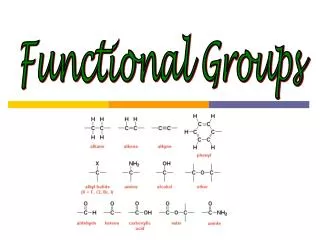
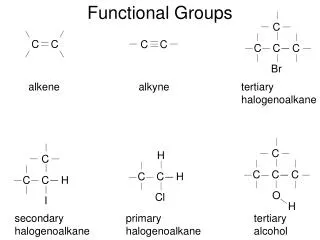
Alkene SeriesGeneral formula: CnH2nhydrocarbon with one double bond (unsaturated)
Alkyne SeriesGeneral formula: CnH2n-2hydrocarbon with one triple bond (unsaturated)
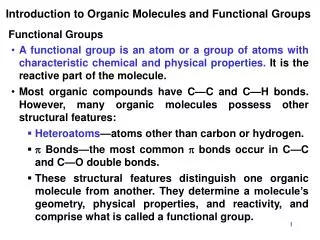
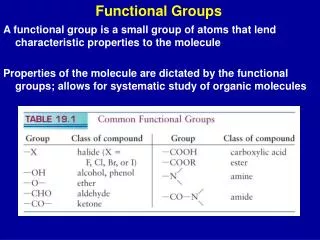
Functional Group • Group of atoms frequently attached to carbon “skeletons” • Usually involved in chemical reactions
Alcohols • Polar • Help to dissolve organic compounds
Aldehydes • Carbonyl group is on the terminal (end) carbon
Ketones The carbonyl group is “sandwiched” between two chains of carbons
Carboxylic Acids • Polar tendencies • Possible for H to dissociate due to the two electronegative • oxygen atoms pulling shared electrons away from hydrogen
Amino Group Amino acids – important in proteins, combines both an amino group (acts as a base due to unshared pair of electrons on Nitrogen) and a carboxyl group
Sulfhydryl • Help to stabilize intricate structures of proteins
Phosphate group • Found in ATP and DNA
Try this ….. http://www.proprofs.com/flashcards/cardshow.php?title=functional-groups-quiz&quesnum=11