Adaptive Immunity
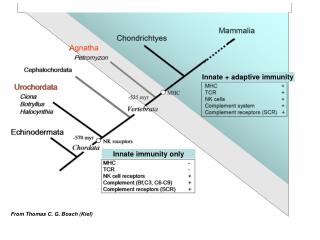
This overview explores the intricate world of adaptive immunity in vertebrates, detailing key mechanisms such as specificity, recognition modules including BCR, TCR, and antibodies, and the crucial role of gene rearrangement in generating diversity. It dives into small lymphocyte types—B-cells and T-cells—and their functions, highlighting processes such as clonal selection, antigen presentation via MHC, and the generation of immunological memory. We also address the significance of self-tolerance, the importance of antibodies in pathogen defense, and the principles behind vaccination.

Adaptive Immunity
E N D
Presentation Transcript
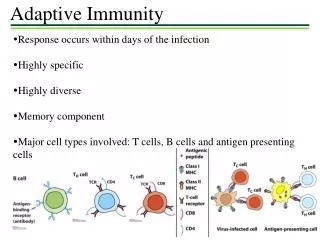
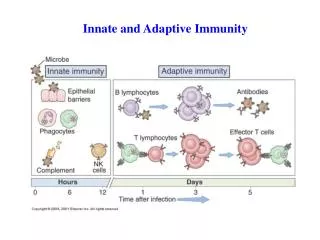
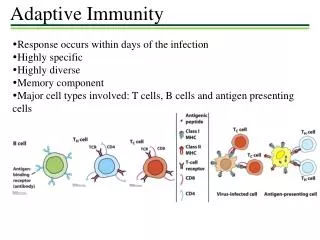
Adaptive Immunity • Vertebrates only • Specificity - recognition modules - BCR, Ab and TCR - gene rearrangement is the source of diversity - clonal selection • Small lymphocytes - types and sub-types - functions
Recognition concept Receptor or Antibody molecule Antigen - structure recognized by an Ab, BCR or TCR Epitope - particular sub-structure of the Ag that is bound Affinity - how much a molecule likes to bind to a structure
Small lymphocyte sub-types B-cells BCR is Immunoglobulin (Ig) Plasma cells - effector cells that secrete Ab T-cells Tc = cytotoxic (CD8+) TH = helper T-cells (CD4+) Th1 (inflammation) Th2 (help B-cells make AB)
Recognition modules of Adaptive immunity B-cell receptor B cells T cells
Native vs Denatured Antigen processing Major Histocomp-atibility (MHC) B-cells T-cell
Intracellular pathogens Extracellular pathogens All nucleated cells APC Only immune cells Professional APC APC - Antigen Presenting Cells Professional APC - macrophages - B cells - Dendritic cells
Figure 1-26 MHC class I communicates with Tc cells
Figure 1-27 MHC class II communicates with TH cells Dendritic cells interact with naïve T-cells and initiate differentiation
Parasitic infection Parasite + Mast cell • Neutralization • Opsonization • Inflammation Inflammation Mast cell activated Expel and/or destroy pathogen
Principles of Adaptive Immunity Diversity Specificity Memory Self-tolerance
Gene Rearrangement is the source of Diversity Germline configuration Diversity Alternative combinations Imprecise joints Different types of chains B-cells - somatic hypermutation In the absence of antigen
Clonal Selection Each cell = one receptor Millions of lymphocytes are generated Small subset will recognize a pathogen Proliferation and differentiation Acquired immunity - the adaptive immunity provided by immunological memory
Figure 1-22 Antibodies are usually very specific
Figure 1-30 Some memory lymphocytes Few specific lymphocytes Many lymphocytes Concept Behind Vaccination
Pre-industrialization infants built immunity naturally • Post-industrialization polio rate increased in adults hence a need for vaccination
Polio Vaccine - Inactive vs Oral “live” version VDPV - vaccine derived polio virus - mutations can lead to polio at extremely low rate
Principle of Self-tolerance B-cells with BCR that bind to self will undergo Apoptosis More complicated scheme of selection for T cells
Selection of T cells Thymocytes Positive selection -Self MHC 3. Negative selection Mechanism of Self-tolerance
Immunodeficiencies Inherited deficiencies e.g. Bubble boy disease Stress induced nutrition, emotional Pathogen caused deficiencies HIV - attacks CD4 T lymphocyte
Figure 1-32 Cells and molecules involved in Hypersensitivity Diseases • IgE • IgG • CD4 TH1 • CD8 CTL
Figure 1-33 Insulin-Dependent Diabetes Mellitus Beta cells of the Islets of Langerhans
Figure 1-34 Inflammatory Adaptive Immune Response Hygiene Hypothesis