Understanding Elements, Compounds, and Mixtures: A Comprehensive Guide
This guide explores the fundamental concepts of elements, compounds, and mixtures in chemistry. An element is the smallest unit of matter that retains its properties, while a compound consists of two or more elements chemically combined, possessing new properties. Mixtures, on the other hand, are physically combined substances that can be easily separated. The guide also discusses atomic structure, molecular formation, and key examples like water, table salt, and DNA. Discover how these foundational concepts are intertwined in both living and non-living substances.

Understanding Elements, Compounds, and Mixtures: A Comprehensive Guide
E N D
Presentation Transcript
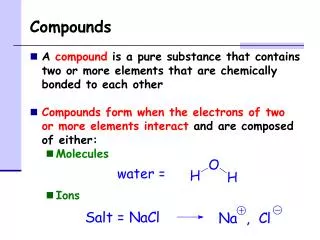
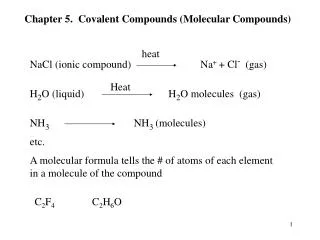
What are elements, compounds & mixtures? • An element is the smallest part of a substance (matter) that still retains all the properties of that substance. • Is pure • A compound is two or more substances chemically combined, very difficult to separate, has new chemical & physical properties. • Can be pure • A mixture is two or more substances physically combined, easily separated, no change in physical or chemical properties. • By defintion is not pure
Don’t forget… • Atoms are the smallest part of an element. • Molecules are the smallest part of a compound. • Mixtures can be made up of elements, compounds, or both. • Symbols represent elements. • Formulas represent compounds.
Atoms combine • To fill their outermost shell with 8 electrons • To become more stable • To create compounds • By sharing, gaining or losing electrons.
Remember the Kinetic Theory of Matter? • All atoms are in constant, random motion all the time. • Atoms make up compounds, so compounds are also in motion all the time.
In fact, • elements combine to form all known living and non-living substances.
Examples you should know • table salt, vinegar, water, baking soda, lye (drano®), sugar (glucose), gasoline, carbon dioxide, bleach, oxygen and DNA(deoxyribonucleic acid) to name a few…
DNA is a complex molecule • Made of three parts: • a phosphate group • a sugar group • one of four types of nitrogen bases • Adenine (A), thymine (T), Guanine (G) and cytosine (C). • To form a strand of DNA, nucleotides are linked into chains, with the phosphate and sugar groups alternating.
Water Water molecule Lewis dot diagram of a water molecule
Let’s take a closer look… Water Hydrogen Oxygen odorless, colorless liquid density: 1 g/cm3 Boiling Point: 100 °C Odorless, colorless, highly flammable gas Density : .088 g/cm3 boiling point: -252.87 ˚C Odorless, colorless, tasteless gas Density: 1.495 g/cm3 Boiling point : -189˚C
Let’s take a closer look… Carbon Dioxide Carbon Oxygen Colorless gas Density: .0019 g/cm3 Boiling Point: -78 °C Black or colorless solid Density : 2.27 g/cm3 Boiling point : 4027 ˚C Odorless, colorless, tasteless gas Density: 1.495 g/cm3 Boiling point : -189˚C
Let’s take a closer look… Salt Sodium Chlorine White, crystalline solid Used as a flavoring and a preservative Density: 2.16g/cm3 Boiling Point: 1413 ˚C Soft, silvery-white metal solid Reacts violently with water Density: .968 g/cm3 Boiling Point: 883˚C Yellow-green poisonous gas Used as a disinfectant Density: 2.03 g/cm3 Boiling Point: -34 ˚C
In conclusion… • Compounds have properties that are different from the elements that make them up.
Compounds that contain carbon are called . . . • Organic compounds • Have a special branch of chemistry to study them: Organic chemistry