Sonnets
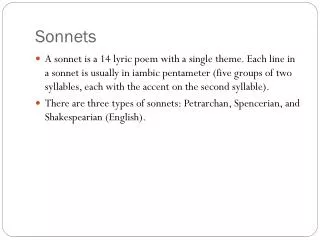
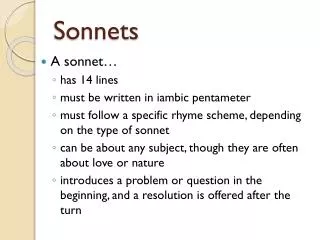
Sonnets originated in Italy in the 12th century, with notable poets like Dante Alighieri, Guido Cavalcanti, and Michelangelo shaping the form. Characterized by 14 lines and a rhyme scheme of abbaabbacdecde, the Italian sonnet consists of an octave that presents a problem and a sestet that offers a resolution. Petrarch, the most famous sonneteer, passionately wrote 366 sonnets for his muse, Laura. The sonnet form later evolved in England, notably through Thomas Wyatt and William Shakespeare, who introduced the Elizabethan sonnet with its own distinct structure and rhyme pattern.


Sonnets
E N D
Presentation Transcript
History Originated in Italy sometime in the 12th Century Famous Italian “sonneteers”: Dante Alighieri, Guido Cavalcanti, and Michelangelo Fourteen lines with a strict rhyme scheme: abbaabbacdecde Structure of a typical Italian sonnet forms an “argument” The first eight lines (an octave) describes a “problem” The last six lines (a sestet) proposes a “resolution”
Petrarch (1304 – 1374) Most famous Italian sonneteer Left the priesthood after seeing a woman named “Laura” in a church on Good Friday in 1327 “Laura,” most likely Laura de Noves, a married woman, became Petrarch’s obsession Petrarch wrote 366 sonnets for Laura She remained faithful to her husband and died in 1348, leaving Petrarch devastated
Petrarchan Sonnet Octave (The Problem) Filled with consuming thought that divides me (a)from other men, and sends me through life alone, (b)from hour to hour, out of myself I’m flown, (b)searching to find her, from whom I should flee. (a) And seeing her pass by, so sweet and deadly, (a)my spirit quivers to take wing, fly on, (b)so many armed sighs, with her, are gone, (b)whom Love and I know - our beautiful enemy. (a)
Petrarchan Sonnet Sestet (The Resolution) Surely, if I am not wrong, from that brow (c)high and clouded, a ray of pity shines, (d)that, to some degree, brightens my sad heart. (e) Then, rousing my mind, I consider how (c)to tell her of this unwise choice of mine, (d)yet, having so much to say, I dare not start. (e)
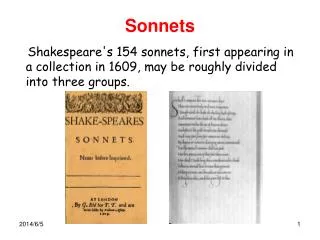
Petrarch to Shakespeare Petrarchan (or Italian) sonnets were introduced to England in the early 16th Century by Thomas Wyatt. The “Elizabethan Sonnet,” made popular by William Shakespeare, became the norm for sonnet writing in England.
Elizabethan Sonnets New rhyme scheme: abab cdcd efef gg Almost always written in iambic pentameter (a series of five iambs . . . an unstressed syllable followed by a stressed syllable) Instead of an octave followed by a sestet, these sonnets have four quatrains followed by a couplet The couplet usually contains a “twist” or a “new look” on the theme of the sonnet