Download
1 / 26
270 likes | 388 Vues
This research explores the significance of high-velocity clouds (HVCs) as essential components in star-forming galaxies. By examining HVC distances, mass, and densities, various studies reveal the potential correlation between HVCs and star formation rates. The paper discusses methods for determining HVC distances through direct measurements and HI observations, highlighting their connection to galaxy evolution. Additionally, this investigation raises critical questions about the relationship between HVCs and underlying galactic structures, contributing to our understanding of intergalactic processes. ###

E N D
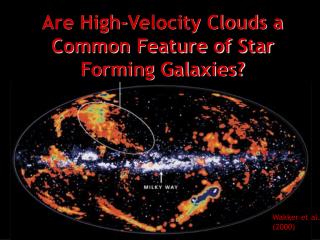
Are High-Velocity Clouds a Common Feature of StarForming Galaxies? Wakker et al. (2000)
HVCs as Local Group Building Blocks? Grebel 1998
MHI ~ 4.5 D2 (kpc) Size ~ 0.4 deg2 NHI ~ 1019 cm-2 At 5 kpc MHI = 115 Mo dHI = 60 pc nHI = 5 x 10⁻² cm-3 Compact HVC Typical HI Masses and Sizes At 1 Mpc MHI=4.6 x 10⁶ Mo dHI=12 kpc nHI=2.5 x 10⁻⁴ cm-3 At 50 kpc MHI=1.15 x 10⁴ Mo dHI=600 pc nHI=5 x 10⁻³ cm-3 At 500 kpc MHI=1.15 x 10⁶ Mo dHI=6 kpc nHI=5 x 10⁻⁴ cm-3
HVC Distances • Direct methods
Direct Distance Determinations • Large complexes using halo stars • Complex A: 4 - 10 kpc • Complex M: < 4 kpc • Complex WE: < 13 kpc • HVC279-33+120: < 50 kpc • Complex C: > 6 kpc • ~5 other HVCs: > 0.3 kpc
HVC Distances • Direct methods • Ha emission measurements
HVC Distances • Direct methods • Ha emission measurements • Deep HI observations of groups
Deep Surveys of Groups • Small area in Local Group-like groups, 0 star-free HI objects to 7 x 10⁶ Mo(Zwaan 2001) • Many other surveys of groups down to a few x 107 Mo have also found 0(e.g. Lo et al. 1979, Dahlem et al. 2001) Sculptor Group None to ~107 Mo(Putman et al. 2003) 2% of group, None to 3 x 10⁶ Mo(de Blok et al. 2001) Same for Centaurus A
HVC Distances • Direct methods • Ha emission measurements • Deep HI observations of groups and spiral galaxies • Lya absorbers
HVC Distances • Direct methods • Ha emission measurements • Deep HI observations of groups and spiral galaxies • Lya absorbers • Ionization constraints
Incoming Star Formation Fuel? Wakker et al. (2000)
Smooth Accretion of Intergalactic Gas Bryan & Norman Bowen, Pettini & Blades (2002)
Mergers and Satellite Accretion Harding et al.
Our Galaxy Putman et al. (2003)
M81 Group (Yun, Ho & Lo 1994)
Leo Ring (Schneider et al. 1981)
Anomalous HI around galaxies • M101 (van der Hulst & Sancisi 1988) • M83 (O. K. Park et al.) • FCC35 (Putman et al. 1998) • NGC 2442 (Ryder et al. 2001)
NGC 2403 (lowest contour ~ 2 x 1019 cm-2; Fraternali et al. 2002)
Questions to be answered • Is there a relation between the presence of HVCs and a galaxy’s star formation rate?
SINGG = Survey for Ionization in Neutral Gas Galaxies (Meurer et al.) This candidate eldot was not detected in follow-up spectroscopy.
NGC 1533 Ryan-Weber et al. (2003)
Questions to be answered • Is there a relation between the presence of HVCs and a galaxy’s star formation rate? • What type of environment are galaxies with HVCs found in? Are there near-by companions? • How are HVCs related to the Ly-limit absorbers which also are commonly found in galaxy halos? And the O VI and lower column Lya absorbers which are often 100s of kpc from a galaxy? • How do HVCs fit into the CDM model of galaxy formation?
Target Selection • Northern extension of HIPASS (d = 2 – 25o ) • Based on number of sources found in southern HIPASS, there should be ~900 sources • Stick to v < 2000 km/s, should be ~300 • ALFA resolution ~10 kpc at 10 Mpc • High-sensitivity mapping of the sample (to NHI~1019 cm-2, r~100 kpc) should provide information on the frequency and location of HVCs