Download
1 / 22
220 likes | 320 Vues
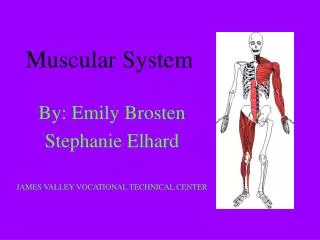
The muscular system comprises over 600 muscles, contributing to 45% of body weight, packed with mitochondria and blood vessels. It plays key roles in locomotion, posture, temperature regulation, respiration, and internal movement. Muscles exhibit four main characteristics: excitability, contractibility, extensibility, and elasticity. There are three main types of muscle tissue: skeletal (voluntary, striated), smooth (involuntary, non-striated), and cardiac (involuntary, striated with intercalated disks). Understanding these components is essential for studying human anatomy and physiology.

E N D
Terminology (pg. 167) myo- fasciculus sarco- platys iso- tonos syn- -trophy tetanos caput
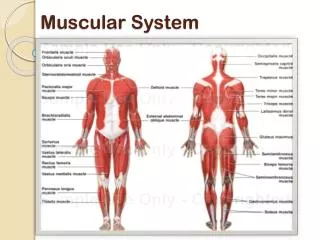
Introduction • Over 600 muscles • Lots of mitochondria and blood vessels • 45% of body weight is muscles
Functions • Locomotion: move skeleton
Guarding entrances and exits (sphincters)
1. Excitability-ability to respond Characteristics
Types-Skeletal striated-appear lined voluntary lots of nuclei in the cell
Smooth • Non-striated • Involuntary • Spindle shaped
Cardiac • Striated • Involuntary • Branched intercolated disks