Probability Distributions
This problem explores the concept of probability distributions through a true/false test scenario. It discusses how to calculate binomial probabilities in various situations, such as guessing answers or scoring in free throws. The exercise involves determining the probabilities of different outcomes after making random guesses on a quiz and analyzing the expected values in various contexts. Additionally, it addresses the conditions necessary to apply binomial probability distributions effectively.

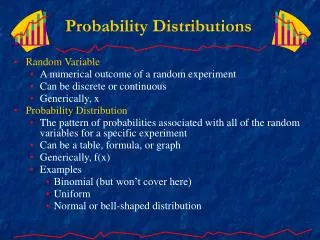
Probability Distributions
E N D
Presentation Transcript
Problem: Suppose you are taking a true or false test with 6 questions…. But you didn’t study at all • Take out a coin and a piece of paper – you will flip your coin to answer the following problems. • Heads is true, tails is false.
STATISTICS 257 Final Exam – Oh no! Get out your coin and guess the following: 1. If a gambling game is played with expected value 0.40, then there is a 40% chance of winning.
… I lost my notebook… • 2. If A and B are independent events and P(A)=0.37, then P(A|B)= 0.37.
…the textbook is too heavy • 3. If A and B are events then P(A) + P(B) cannot be greater than 1.
... I’m never going to really need this stuff anyway, right? • 4. If P(A and B) = 0.60, then P(A) cannot be equal to 0.40.
…why are the questions so long? • 5. If a business owner, who is only interested in the bottom line, computes the expected value for the profit made in bidding on a project to be -3,000, then this owner should not bid on this project.
…. Oops, I left my calculator in my locker • 6. Out of a population of 1000 people, 600 are female. Of the 600 females 200 are over 50 years old. If F is the event of being female and A is the event of being over 50 years old, then P(A|F) is the probability that a randomly selected person is a female who is over 50.
So how did you do? • #1 – False • #2 – True • #3 – False • #4 – True • #5 – True • #6 – False Tally up your responses – Did you pass?
The Distribution of scores on the test – why is it more likely to get 3 right than to get 6 right?
Try to determine the following probabilities when guessing your answers on a true or false test: • 0 right • 1right
Try to determine the following probabilities when guessing your answers on a true or false test: 0 right 1right 2 right 3 right 4 right 5 right 6 right x right
Probability Distribution for Guessing on 6 True or False Questions http://www.mathsisfun.com/data/quincunx.html
The Binomial Probability Distribution • A binomial probability is an experiment where we count the number of successful outcomes over n independent trials Question: Is guessing the answer on 6 true / false questions a binomial probability?
Calculating a Binomial Probability • In general, we can calculate a binomial probability of x successes on n independent trials as: Eg) What is the probability of guessing 4 out of 6 answers on a true or false quiz?
Try the following: You are shooting 8 free throws and you have a 75% of scoring on each. What is the probability that you will: • Score on 0 shots? • Score on 1 shot?
Try the following: You are shooting 8 free throws and you have a 75% of scoring on each. What is the probability that you will: • Score on 0 shots? • Score on 1 shot? • Score on 2 shots? • Score on at least 2 shots?
You are shooting 8 free throws and you have a 75% of scoring on each. What is the probability that you will: 5. Score at least 7 shots? 6. Score 6 or 7 shots? 7. Score all of your shots except the last one?
You are shooting 8 free throws and you have a 75% chance of scoring on each. • How many shots do you expect to score?
The Expected Value of a Binomial • In general, the expected value of a binomial probability is given as: Try: What is the expected value of • Guessing on 100 True / false questions? • Rolling a dice 600 times and counting 6s? • Shooting 200 baskets with a 75% chance of making each one
Try the following: Suppose that 2% of all calculators bought from Dollarama are defective. You randomly collect 20 of them. What is the probability that: • None of them are defective? • 2 or more are defective? • In a batch of 1500, how many do you expect to be defective?
Summary: What is a probability distribution? How do you calculate a binomial probability? What are two conditions that you need in order to use a binomial probability calculation? Why do you multiply a binomial probability by nCx? • p. 385 #1, 2, 3, 5, 6bc, 7ab, 8ab, 15, 17 Challenge: 10, 11