Download
1 / 32
320 likes | 438 Vues
Explore the fascinating journey of electromagnetic radiation, starting from the 1600s when sunlight was considered the purest form of light. Delve into Isaac Newton's prism experiments and Christian Huygens' wave theory. Discover how Maxwell unified electricity, magnetism, and light through groundbreaking equations. Learn about the discovery of infrared and ultraviolet rays, radio waves, and X-rays. Understand the electromagnetic spectrum and the properties of different wavelengths, frequencies, and their interactions with matter.

E N D
Light • 1600’s – sunlight considered purest form of light • 1665 – Isaac Newton – passed a beam of sunlight through a prism • Beam spread out • band of colors (Roy G. Biv) • Rejoined the colors using a 2nd prism & got white light again
Newton • Thought light made up of tiny particles with no mass • explains why shadows have sharp edges • Couldn’t explain how particles of different colors were different or why were refracted differently by prism • Couldn’t explain why 2 beams of light didn’t affect each other when they crossed • particles of light should collide off each other
Christian Huygens • 1678: suggested light was composed of waves • explained why 2 beams of light could cross each other without being disturbed • explained refraction in prism: - different colors have different wavelengths • People were used to waves in water • Water waves move around an obstruction • Waves couldn’t explain shadows with sharp edges
Wave Vocabulary • Transverse and Longitudinal • Wavelength • Frequency • Amplitude • Velocity
Transverse Wave Direction of displacement is at right angle to direction of travel
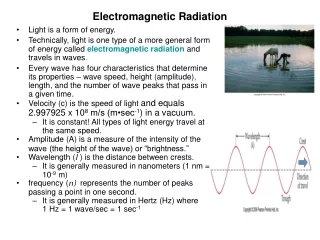
Wavelength vs. Frequency • WAVELENGTH = Distance light travels to complete 1 cycle • FREQUENCY = Number of cycles completed in 1 second
Wave Velocity • The speed of wave in direction it is traveling • Velocity = wavelength x frequency • Velocity =
Light: Particles vs. Waves • Huygens had the better argument, but Newton was more famous • people went with Newton's theory: Light was particles! • Speed of light 1st determined about 1676 by a Danish astronomer • Speed of light = 3.0 X 10⁸ m/sec
Calculating Wavelengths of Light • Visible light waves have lengths of ~ 1/20,000 cm • Red was a little longer, violet a little shorter • short wavelength explains why light cast sharp shadows despite being waves • Waves can only bend around obstacles that are about the same length • cannot bend around anything substantially longer than itself
The Ether • Water waves move in water • Sound waves move in air • Light waves move through a vacuum • Gravity, Electricity, & Magnetism also felt across a vacuum • Couldn't accept this: • Postulated a subtle form of matter called ether • not easily detectable • Didn’t give up “Ether” idea until 1900
Maxwell • 1864-1873 worked out equations describing electricity & magnetism • Electric & magnetic fields cannot exist independently • electromagnetic radiation in Maxwell’s equation moved at the same speed as light! • Could not be a coincidence!
Light that can’t be seen? • Light was electromagnetic radiation! • Maxwell’s equations unified electricity, magnetism, & light • But visible light only accounts for a fraction of Maxwell’s equations • What about other frequencies and wavelengths?
Heat & Light: Separate or the same? • Herschel – 1800 studied the spectrum with a thermometer & found the highest temperature at the red end and coolest at violet end • Placed the thermometer beyond the red & the temp was higher there than anywhere in the visible spectrum • Discovered infrared rays, which we cannot see
Infrared Radiation • By 1850, infrared rays were demonstrated to have all the properties of light • except that they could not be seen by eye
Silver Nitrate as detector • 1614: knew that silver nitrate (white cmpd) darkens on exposure to sunlight • 1770: Scheele soaked strips of white paper in silver nitrate solutions and placed them in different parts of the spectrum • Darkened least quickly in red and fastest in violet • ? the first photographs
Discovery of ultraviolet! • 1801: After Herschel's used thermometers to discover infrared • Ritter repeated Scheele’s experiment with the paper soaked in silver nitrate & put the strips beyond the violet • Strips darkened even quicker than in violet light • ultraviolet light was discovered!
Radio Waves • 1888: Hertz used an oscillating electric current to emit electromagnetic radiation • Had detector that could move around to map the electromagnetic wave & determine its length • Found radio waves far beyond infrared radiation • these have wavelengths from cm to km
X-Rays • 1895: Roentgen discovered that his cathode ray tube was emitting radiation = X-rays
Short wavelength Rapid frequency High energy Comparing • Long wavelength • Slow frequency • Low energy All electromagnetic radiation has the same velocity: 3.00 x 10⁸ m/sec 3.00 X 10⁸ m/sec =
Heat Flow • Objects hotter than their surroundings lose heat as electromagnetic radiation • the higher the temp, the more intense the radiation • Hot objects glow! • they glow different colors at different temperatures!
Ultraviolet Catastrophe • Classical physics - Assume that every wavelength has an equal chance of being radiated • Classical wave model could not explain why different colors were emitted at different temperatures
Planck • The shorter the wavelength, the less chance it has to be emitted! • Matter can gain or lose energy only in very small increments = quanta
What physical explanation goes with Planck’s assumption? • Pre-Planck: • Energy was considered to be continuous • could be broken into smaller & smaller bits indefinitely • Planck: • Energy consists of tiny particles that can’t be divided into anything smaller