Download
1 / 10
100 likes | 266 Vues
Kinetic energy (KE) is the energy of motion and can be calculated using the formula KE = ½ mv², where m is mass in kilograms and v is velocity in meters per second. This guide explains the variables in the formula and provides examples to illustrate how to calculate kinetic energy with different masses and speeds. Doubling the mass doubles the kinetic energy, while doubling the speed quadruples it. Finally, we demonstrate how to apply this knowledge in real-world scenarios, such as analyzing the kinetic energy of a car before a collision.

E N D
Kinetic Energy Energy of Motion
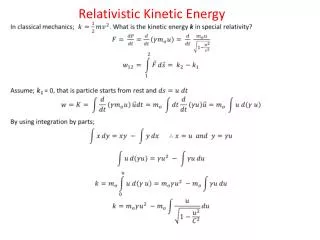
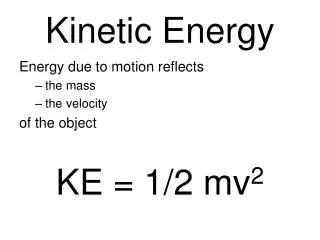
Kinetic Energy • KE = ½ mv2 • m = mass • v = speed (velocity)
AAK! A Formula! • The letters are variables and they’re placeholders for actual numbers. • Because the letters are side-by-side, you multiply them together. • To figure out kinetic energy, put numbers for both and multiply together.
But what about v2? • That just means you take the number for v and multiply it by itself. • For example, if v = 3, then v2 = 3x3 • 3x3 = 9
What units do I use? • Mass is measured in… • Kilograms • Speed is measured in… • Meters/Second • If you square speed, you get… • Meters2/Second2
kg x m x m= s x s • kg•m2= Joules s2
Let’s Try Some Equations • KE = 1/2 mv2 • For example, plug in 4 kilograms for m and 2 m/s in for speed. • What’s the kinetic energy? • (1/2)(4kg)(2 m/s)(2 m/s) • 8 joules
What if you double the mass? • Ex 1: mass = 4 kg, speed = 2 m/s • KE = 1/2 (4kg)(2 m/s)(2 m/s) • KE = 8 Joules • Ex 2: mass = 8 kg, speed = 2 m/s • KE = 1/2 (8kg)(2 m/s)(2 m/s) • KE = 16 Joules • So, if you double the mass, you double the energy--how were our results?
What if you double the speed? • Ex 1: mass = 4 kg, speed = 2 m/s • KE = 1/2 (4kg)(2 m/s)(2 m/s) • KE = 8 Joules • Ex 2: mass = 4 kg, speed = 4 m/s • KE = 1/2 (4kg)(4 m/s)(4 m/s) • KE = 32 Joules • So, if you double the speed, you QUADRUPLE the energy--how were our results?
Learning Check! • Car crash tests have cars smashing into walls traveling at about 50 km/hr. This is about equal to 15 m/s. An average car has a mass of about 1000 kg. How much kinetic energy does the car have right before it hits the wall? • KE = 1/2 mv2 • KE = 1/2 (1000 kg)(15 m/s)2 • KE = 112500 Joules