Understanding Population Characteristics and Growth Dynamics
120 likes | 254 Vues
In this lesson for October 8-9, 2013, students will explore the key characteristics of populations, including geographic distribution, density, and growth rates. They will learn about different types of population growth such as logistic and exponential growth. The lesson will differentiate between density-dependent factors, like competition and predation, and density-independent factors, such as natural disasters. Additionally, students will examine life survivorship curves and patterns of dispersion within populations. Homework includes reading “Winter Plants” in "The Forest Unseen".


Understanding Population Characteristics and Growth Dynamics
E N D
Presentation Transcript
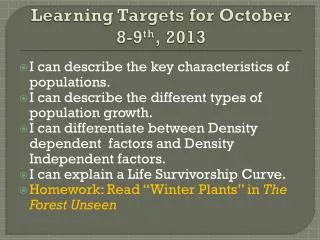
Learning Targets for October 8-9th, 2013 I can describe the key characteristics of populations. I can describe the different types of population growth. I can differentiate between Density dependent factors and Density Independent factors. I can explain a Life Survivorship Curve. Homework: Read “Winter Plants” in The Forest Unseen
How Populations Grow • Characteristics of Populations: • Three important characteristics of a population are its geographic distribution, density and growth rate. • Population density is the number of individuals in an area. • Population Growth is the number of births, the number of deaths and the number of individuals entering or leaving the population. • Geographic Distribution is how the organisms are arranged (distributed) on earth (not just where they are found).
Population Growth: • Key Terms to know: • Logistic growth – when the population growth slows or stops • Carrying capacity – the limit of individuals that the environment can sustain. • Exponential growth – when the individuals are reproducing at a constant rate.
Survivorship Curves • A Survivorship Curve is a plot of the proportion of numbers in a group alive at a given age.
Patterns of Dispersion within a Population Clumped; many organisms are clumped do to resource supply. Uniformed; many organisms are uniformly dispersed due to territories. Random; many organisms are found in random due seed dispersal.
Limits To Growth: • Density Dependent Factors: these limit the population when the density becomes too great. • Density dependent factors include competition, predation, parasitism and disease • Density Independent Factors: limit the population regardless of the population size. • Examples include damming rivers, natural disasters, clear cutting forests, seasonal cycles, etc.
Population Comparison: • Turn to page 123 in your text book. • Answer the question do fruit flies and rabbits show similar trends in population growth?