Data Organization - B-trees
This document explores B-trees, a balanced multi-way tree structure, ideal for indexing in databases. It covers essential concepts, including primary and secondary indices, index density, and access methods that facilitate efficient queries. Key topics include search algorithms, insertion and deletion mechanics, and the advantages of B-trees over traditional indexing methods like ISAM. The structure's overall performance, including access time and maintenance overhead, is also discussed. Discover how B-trees can optimize data retrieval and storage in modern database systems.

Data Organization - B-trees
E N D
Presentation Transcript
A simple index Index file Brighton A-217 700 Downtown A-101 500 Downtown A-110 600 Mianus A-215 700 Perry A-102 400 ...... A-101 A-102 A-110 A-215 A-217 ...... Index of depositors on acct_no Index records: <search key value, pointer (block, offset or slot#)> To answer a query for “acct_no=A-110” we: 1. Do a binary search on index file, searching for A-110 2. “Chase” pointer of index record
Index Choices 1. Primary: index search key = physical order search key vs Secondary: all other indexes Q: how many primary indices per relation? 2. Dense: index entry for every search key value vs Sparse: some search key values not in the index 3. Single level vs Multilevel (index on the indices)
Measuring ‘goodness’ On what basis do we compare different indices? 1. Access type: what type of queries can be answered: • selection queries (ssn = 123)? • range queries ( 100 <= ssn <= 200)? 2. Access time: what is the cost of evaluating queries • Measured in # of block accesses 3. Maintenance overhead: cost of insertion / deletion? (also BA’s) 4. Space overhead : in # of blocks needed to store the index
Indexing Primary (or clustering) index on SSN
Indexing Secondary (or non-clustering) index: duplicates may exist • Can have many secondary indices • but only one primary index Address-index
Indexing secondary index: typically, with ‘postings lists’ Postings lists
Indexing Primary/sparse index on ssn (primary key) >=123 >=456
Indexing Secondary / dense index Secondary on a candidate key: No duplicates, no need for posting lists
Summary • All combinations are possible • at most one sparse/clustering index • as many as desired dense indices • usually: one primary index (probably sparse) and a few secondary indices (non-clustering)
>=123 >=456 block ISAM What if index is too large to search in memory? 2nd level sparse index on the values of the 1st level
>=123 >=456 124; peterson; fifth ave. ISAM - observations What about insertions/deletions?
ISAM - observations What about insertions/deletions? overflows 124; peterson; fifth ave. Problems?
ISAM - observations • What about insertions/deletions? overflows 124; peterson; fifth ave. • overflow chains may become very long - what to do?
ISAM - observations • What about insertions/deletions? overflows 124; peterson; fifth ave. • overflow chains may become very long - thus: • shut-down & reorganize • start with ~80% utilization
So far • … indices (like ISAM) suffer in the presence of frequent updates • alternative indexing structure: B - trees
Overview • primary / secondary indices • multilevel (ISAM) • B - trees, B+ - trees • hashing • static hashing • dynamic hashing
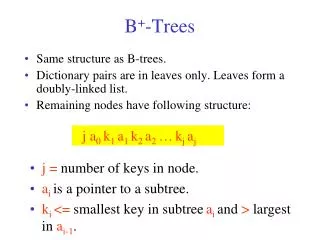
B-trees • the most successful family of index schemes (B-trees, B+-trees, B*-trees) • Can be used for primary/secondary, clustering/non-clustering index. • balanced “n-way” search trees
6 9 <6 >9 <9 >6 3 1 7 13 B-trees Eg., B-tree of order 3:
B-tree Nodes pn p1 … vn-1 v1 v2 Vn-1 <= v v1 <= v < v2 v<v1 Key values are ordered MAXIMUM: n pointer values MINIMUM: n/2 pointer values (Exception: root’s minimum = 2)
Properties • “block aware” nodes: each node -> disk page • O(logB (N)) for everything! (ins/del/search) • typically, if m = 50 - 100, then 2 - 3 levels • utilization >= 50%, guaranteed; on average 69%
6 9 <6 >9 <9 >6 3 1 7 13 Queries • Algorithm for exact match query? (eg., ssn=8?)
Queries • Algorithm for exact match query? (eg., ssn=8?) 6 9 <6 >9 <9 >6 3 1 7 13
Queries • Algo for exact match query? (eg., ssn=8?) 6 9 <6 >9 <9 >6 3 1 7 13
Queries • Algo for exact match query? (eg., ssn=8?) 6 9 <6 >9 <9 >6 3 1 7 13
Queries • Algo for exact match query? (eg., ssn=8?) 6 9 <6 H steps (= disk accesses) >9 <9 >6 3 1 7 13
Queries • what about range queries? (eg., 5<salary<8) • Proximity/ nearest neighbor searches? (eg., salary ~ 8 )
6 9 <6 >9 <9 >6 3 1 7 13 Queries • what about range queries? (eg., 5<salary<8) • Proximity/ nearest neighbor searches? (eg., salary ~ 8 )
6 9 <6 >9 <9 >6 3 1 7 13 Queries • what about range queries? (eg., 5<salary<8) • Proximity/ nearest neighbor searches? (eg., salary ~ 8 )
B-trees: Insertion • Insert in leaf; on overflow, push middle up (recursively) • split: preserves B - tree properties
6 9 <6 >9 <9 >6 3 1 7 13 B-trees Easy case: Tree T0; insert ‘8’
6 9 <6 >9 <9 >6 3 1 7 13 B-trees Tree T0; insert ‘8’ 8
6 9 <6 >9 <9 >6 3 1 7 13 B-trees Hardest case: Tree T0; insert ‘2’ 2
13 B-trees Hardest case: Tree T0; insert ‘2’ 6 9 2 1 3 7 push middle up
2 13 1 3 B-trees Hardest case: Tree T0; insert ‘2’ Ovf; push middle 2 6 9 7
13 1 3 B-trees Hardest case: Tree T0; insert ‘2’ 6 Final state 9 2 7
B-trees - insertion • Q: What if there are two middles? (eg, order 4) • A: either one is fine
B-trees: Insertion • Insert in leaf; on overflow, push middle up (recursively – ‘propagate split’) • split: preserves all B - tree properties (!!) • notice how it grows: height increases when root overflows & splits • Automatic, incremental re-organization (contrast with ISAM!)
Pseudo-code INSERTION OF KEY ’K’ find the correct leaf node ’L’; if ( ’L’ overflows ){ split ’L’, by pushing the middle key upstairs to parent node ’P’; if (’P’ overflows){ repeat the split recursively; } else{ add the key ’K’ in node ’L’; /* maintaining the key order in ’L’ */ }
Overview • primary / secondary indices • multilevel (ISAM) • B – trees • Dfn, Search, insertion, deletion • B+ - trees • hashing
Deletion Rough outline of algo: • Delete key; • on underflow, may need to merge In practice, some implementers just allow underflows to happen…
6 9 <6 >9 <9 >6 3 1 7 13 B-trees – Deletion Easiest case: Tree T0; delete ‘3’
6 9 <6 >9 <9 >6 1 7 13 B-trees – Deletion Easiest case: Tree T0; delete ‘3’
B-trees – Deletion • Case1: delete a key at a leaf – no underflow • Case2: delete non-leaf key – no underflow • Case3: delete leaf-key; underflow, and ‘rich sibling’ • Case4: delete leaf-key; underflow, and ‘poor sibling’
6 9 <6 >9 <9 >6 3 1 7 13 B-trees – Deletion • Case1: delete a key at a leaf – no underflow (delete 3 from T0)
6 9 <6 >9 <9 >6 3 1 7 13 B-trees – Deletion • Case2: delete a key at a non-leaf – no underflow (eg., delete 6 from T0) Delete & promote, ie:
9 <6 >9 <9 >6 3 1 7 13 B-trees – Deletion • Case2: delete a key at a non-leaf – no underflow (eg., delete 6 from T0) Delete & promote, ie:
9 <6 >9 <9 >6 1 7 13 B-trees – Deletion • Case2: delete a key at a non-leaf – no underflow (eg., delete 6 from T0) Delete & promote, ie: 3
B-trees – Deletion • Case2: delete a key at a non-leaf – no underflow (eg., delete 6 from T0) FINAL TREE 9 3 <3 >9 <9 >3 1 7 13
B-trees – Deletion • Case2: delete a key at a non-leaf – no underflow (eg., delete 6 from T0) • Q: How to promote? • A: pick the largest key from the left sub-tree (or the smallest from the right sub-tree) • Observation: every deletion eventually becomes a deletion of a leaf key