Understanding Asexual and Sexual Reproduction in Living Organisms
This lesson explores the differences between asexual and sexual reproduction in living organisms. Asexual reproduction involves a single parent and results in clones, with examples like binary fission in bacteria and vegetative reproduction in plants. Sexual reproduction requires two parents, combining genetic material through meiosis, resulting in diverse offspring. The lesson includes creating Venn diagrams to compare the two methods, as well as an interactive activity to visualize cell structures during prophase. Key examples of organisms are provided for both reproduction types.

Understanding Asexual and Sexual Reproduction in Living Organisms
E N D
Presentation Transcript
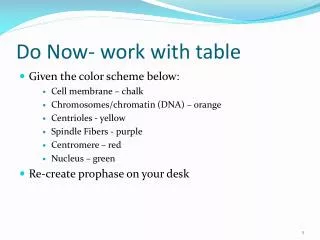
Do Now- work with table • Given the color scheme below: • Cell membrane – chalk • Chromosomes/chromatin (DNA) – orange • Centrioles - yellow • Spindle Fibers - purple • Centromere– red • Nucleus – green • Re-create prophase on your desk
Make a Venn Diagram Asexual Reproduction Sexual Reproduction Both Types of reproduction in living organisms Pass DNA from parent to offspring
Asexual Reproduction • Requires only one parent • Offspring have 100% the same chromosomes as the parent. • In other words, the offspring are exact “clones” of the parent. • Most unicellular organisms reproduce this way. • Mitosis • Movie
Asexual Reproduction • Binary Fission • Bacteria • Protists Binary fission is a form of asexual reproduction where every organelle is copied and the organism divides in two.
Asexual Reproduction • Plant cuttings Vegetative reproduction is a type of asexual reproduction in plants that relies on multi-cellular structures formed by the parent plant. It has long been exploited in horticulture and agriculture, with various methods employed to multiply stocks of plants.
Asexual Reproduction • Budding • Hydra • Movie Budding is a means of asexual reproduction whereby a new individual develops from an outgrowth of a parent, splits off, and lives independently.
Asexual Reproduction • Fragmentation Fragmentation is a means of asexual reproduction whereby a single parent breaks into parts that regenerate into whole new individuals.
Asexual Reproduction • Regeneration Regeneration occurs when a body part has broken off and the organism grows a new one.
Asexual Reproduction • Examples of organisms that reproduce asexually • Hydra • Sea Star • Strawberry • Bacteria • Euglena • Paramecium • Yeast
Sexual Reproduction • Requires two parents that each share ½ of the genetic information. • Offspring share the characteristics of each parent. • Meiosis
Sexual Reproduction • All the members of the Animal Kingdom • Fish • Mammals • Amphibians • Birds • Reptiles • Insects • Crustaceans
Sexual Reproduction • Plant Kingdom • Flowers are the reproductive organs of plants. • Some flowers have both male and female reproductive organs on the same flower. Male flower Female flower
Sexual Reproduction • Examples of organisms that reproduce sexually • Chickens • Iguanas • Lobsters • Sharks • Humans • Butterflies • Sunflowers • Roses
Sexual Reproduction • Happens 2 ways • Internally (inside) • The egg is fertilized by sperm inside the female • Mammals, birds, reptiles, insects, spiders • Externally (outside) • The egg is fertilized by sperm outside the female • The female lays the eggs and then the male fertilizes them. • Fish and some amphibians • Plants and fungi (pollen and spores)
Sex cells vs Body cells • Body Cells • Called “somatic” cells • Divide by cell division (mitosis) • Growth, repair, and maintenance of the body • Sex Cells • Called “gametes” • Include sperm (male) and egg (female) in humans • Divide by meiosis • Each gamete contains only half the number of chromosomes (haploid) • When the gametes join, the offspring will have a full set of chromosomes (diploid)