Download
1 / 7
70 likes | 188 Vues
This guide explores the use of models in scientific explanations, emphasizing their significance in comparing features of objects, living things, and events. It covers how to make and use models to represent observations, describe scientific ideas with accuracy, and apply abstract concepts to familiar situations. The guide also discusses selecting appropriate models, assessing their strengths and weaknesses, developing original models, and justifying their use. By employing clear and relevant language, learners will be able to explain complex events and ideas effectively.

E N D
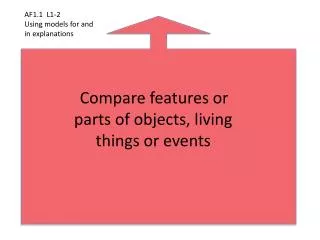
AF1.1 L1-2 Using models for and in explanations Compare features or parts of objects, living things or events
AF1.1 L2-3 Using models for and in explanations Make a model to represent something you have seen
AF1.1 L3-4 Using models for and in explanations Describe scientific ideas using a physical model Describe scientific ideas using scientific terms correctly
AF1.1 L4-5 Using models for and in explanations Explain abstract ideas or events using models in familiar situations Develop a description that uses abstract ideas or models of more than one step Suggest solutions to problems using scientific ideas
AF1.1 L5-6 Using models for and in explanations Select the most appropriate model to explain an idea Say what is good or bad about a model Explain logically ideas or events using abstract models in new situations
AF1.1 L6-7 Using models for and in explanations Develop original models to explain ideas and events Justify the selection of a model to explain an idea Explain events explicitly linking different ideas or models
AF1.1 L7-8 Using models for and in explanations Use criteria to evaluate the appropriateness of a model Use language that is ambitious, clear and relevant to the context Explain events logically, linking different idea or models beyond the level expected in normal lessons