Download
1 / 8
80 likes | 182 Vues
This study explores the optimization of muon event selection using efficient memory lookup techniques to enhance trigger performance in real-time applications. By leveraging correlations in R, U, and V hit data as fingerprints for identifying good muon events, we demonstrate an effective algorithm for processing that simplifies hardware implementation. Our results include 3D scatter plots illustrating robust correlations among muon candidates, with ongoing work focused on defining cuts in R and UV spaces to evaluate efficiency and rejection rates. Aiming to integrate findings into DSP systems soon.

E N D
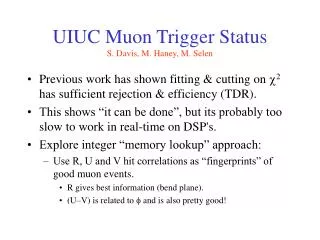
UIUC Muon Trigger StatusS. Davis, M. Haney, M. Selen • Previous work has shown fitting & cutting on c2 has sufficient rejection & efficiency (TDR). • This shows “it can be done”, but its probably too slow to work in real-time on DSP's. • Explore integer “memory lookup” approach: • Use R, U and V hit correlations as “fingerprints” of good muon events. • R gives best information (bend plane). • (U–V) is related to f and is also pretty good!
Algorithm used in this study: • Sparsify hits in each view. • Adjacent multi-hits condensed to a single tube. • Simple to do in hardware. • Find {R,U,V} space-points in each station by exploiting the geometric constraint:U + V – Rcos(22.5) = 65.5 • Gets rid of most random {R,U,V} combinations. • Efficient to do in software. • Can exploit correlations between stations to do this even more efficiently in the end.
3D Scatter plot in {R0,R1,R2} spacefor a sample of good muon candidates(all octants). Points are veryhighly correlated(see rotated plot…) R2 R1 R0 RNis the radial tube in station N. (numbering is out in)
Points are very well fit by a simple plane. Very tight cuts canbe made in this space.This is equivalent to a c2 lookup tablefor a bend-plane fit. R2 R0 R1
uds events • good muon tracks For uds events, only the {R1,R2,R3} combination closest to the “good muon plane” is shown for each event.
3D Scatter plot in {UV0,UV1,UV2} space for a sample of good muon candidates(all octants). UV2 Again, points are highly correlated(rotated plot) UV1 UV0 UVNis (U tube – V tube) in station N. (numbering is out in)
uds events • good muon tracks For uds events, only the {UV1,UV2,UV3} combination closest to the “good muon R-plane” is shown for each event.
Work in Progress: • Defining cuts in {R0,R1,R2} and {UV0,UV1,UV2} spaces. • Evaluate efficiency & rejection. • Tune cuts to make sure we can reproduce the original “fitting & c2 cut” technique. • Implement in DSP. • Hope to have more to show soon…