Preparing for Long-Term Space Habitation: Insights from Experiment Setup of Group 159
The SFINSS-99 study involved 150 volunteers undergoing rigorous selection processes to simulate long-term space living conditions. Three groups—cosmonauts, international researchers, and scientists—were formed, each with unique training and workloads. Uniquely, participants communicated solely in English while living in confined environments for months. The experiment underscored the importance of minimal external support, reflecting real space missions. Analysis included psychological and physiological self-monitoring and challenged the dynamics of crew interaction under extreme isolation.

Preparing for Long-Term Space Habitation: Insights from Experiment Setup of Group 159
E N D
Presentation Transcript
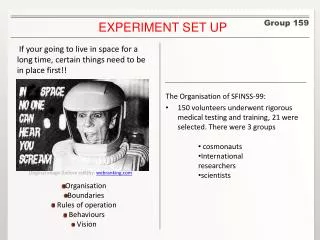
EXPERIMENT SET UP Group 159 • If your going to live in space for a long time, certain things need to be in place first!! • The Organisation of SFINSS-99: • 150 volunteers underwent rigorous medical testing and training, 21 were selected. There were 3 groups • cosmonauts • International researchers • scientists Original image (before edit)by: webranking.com Organisation Boundaries Rules of operation Behaviours Vision
Group 159 • EXPERIMENT SET UP Each group got the chance to interact with the other groups to break up the psychological patterns that had formed. Visits were monitored and analysed. Different groups had different training and work loads and programs to follow. They would all have to communicate in English and do testing also in English. Russian segment was a smaller, 100 cubic metre chamber , they were in spent 240 days living there. They divide time up equally between work, sleep and rest. They are responsible for studying thierownpsychological and physiological effects on themselves. The second cosmonautgroup had a 200 cubic metre chamber. They were there four months and had a longer work schedule, working long hours and concentrated on emergency situations that may occur in space. The third group had a more relaxed work environment.
Group 159 • EXPERIMENT SET UP Extra, Extra: Rules Rule! The Russian psychologists seemed to think that all issues needed to be dealt with internally, as that would be the situation in space, hence; minimal boundaries in place, even when the international crew requested outside intervention. The international crewhad to experience fear and danger before officials implemented a sensible boundary by ‘cutting off interaction with the Russians. This situation highlights the need for non ambiguous rules. Should this experiment have been observational only ? Mars missions will mean extended isolation from the rest of civilisation, in confined in such quarters as the Mir space station (pictured above)