Tropical Cyclone Intrinsic Variability and Predictability
170 likes | 200 Vues
Explore the unpredictability, boundaries, and predictability limits of tropical cyclone forecasts. Learn about intrinsic and environmental factors impacting storm dynamics for better predictions.


Tropical Cyclone Intrinsic Variability and Predictability
E N D
Presentation Transcript
Tropical Cyclone Intrinsic Variability & Predictability Gregory J. Hakim University of Washington 6 March 2013 Q: What is the TC predictability limit? A: We do not know. 67th IHC/Tropical Cyclone Research Forum
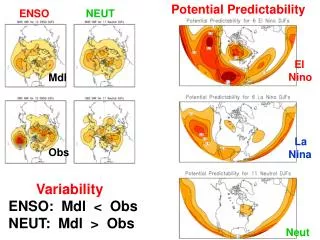
Weather Predictability Limits Lorenz (1982) No theory or predictability limits exist for the TC forecast problem no basis for projecting improvements; devoting resources; etc.
Predictability of First and Second Kindapplied to tropical cyclone prediction Two types of predictability (Lorenz 1975): • First kind: initial conditions • E.g. weather forecasts with fixed SST • Second kind: boundary conditions • E.g. ENSO; CO2, aerosol, orbital, etc. forcing on climate Applied to tropical cyclones: • First kind: “intrinsic” TC-scale initial conditions • Internal storm dynamics • Second kind: environmental “boundary conditions” • SST, shear, dry air intrusions, etc.
Motivation Tropical cyclone forecasts: • Track: steady improvement • better large-scale models & data assimilation • Intensity: much slower improvement • despite improved large-scale environment • cf. ``environmental control'’ Emanuel et al. (2004) Why? Need to understand intrinsic variability. • variability independent of the environment • what aspects are predictable? What timescales? • data assimilation key to realizing predictability, but first need to know limits.
Method • Idealized numerical modeling • Necessary to control environment • CM1 model (George Bryan) • Axisymmetric and 3D (not shown; similar to axi) • Simulate statistically steady state • Extremely long simulations (500 days) • Robust sampling • Variability: EOFs & regression • Predictability: inverse modeling & analogs
Maximum Wind Speed • “superintensity” is a transient effect • wide range of intensity in steady state
Azimuthal wind variability • Bursts of stronger wind that move inward • Dominant period ~4-8 days
Azimuthal wind leading EOFs • EOF1: radial shift of RMW • EOF2: intensity pulsing at RMW
RMW variability linked to far field • Bands of stronger/weaker wind move radially inward • Eyewall replacement cycles
Predictability • Autocorrelation • Analogs (divergence of similar states) • Linear inverse modeling Estimate M statistically (least squares) Verify forecasts from independent data
Predictability: LIM azi wind radial wind Predictability limits: • Clouds: ~12-18 hours • Azimuthal wind: ~ 2-3 days cloud water temperature
Analog Forecasts • Fully nonlinear model • Similar results to LIM • larger initial error due to limited sample
Comparison against operational forecasts (NHC) • Coincidence? • Already at predictability limit? • Intrinsic variability dominates error?
Conclusions • Intrinsic variability • Promotes understanding how environment affects storms • convective bands form in the environment and move inward • Intrinsic predictability • ~48-72 hours • environment can add or subtract from this limit • compares closely with operational forecast errors • Basic research needed! Hakim, G. J., 2011: The mean state of axisymmetric hurricanes in statistical equilibrium. J. Atmos. Sci., 68, 1364--1376. Hakim, G. J., 2013: The variability and predictability of axisymmetric hurricanes in statistical equilibrium. J. Atmos. Sci., 70, in press. Brown, B. R., and G. J. Hakim, 2013: Variability and predictability of a three-dimensional hurricane in statistical equilibrium. J. Atmos. Sci.,70, accepted.