Download
1 / 4
40 likes | 154 Vues
This exploration delves into the fascinating world of bees, highlighting their diverse species, social structures, and unique behaviors. The insights gained from observing bees through hand lenses and microscopes have transformed the understanding of their intricate anatomy, such as the structure of their stingers and wings. By integrating artistic representation with scientific observation, students can appreciate the complexity of bees and their vital role in ecosystems. This study aligns with life science standards, illustrating the importance of using advanced tools to reveal the unseen details of these essential insects.

E N D
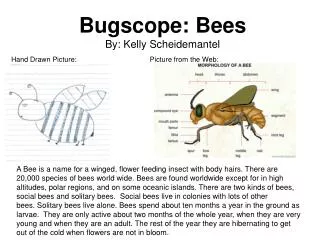
Hand Drawn Picture: Picture from the Web: Bugscope: BeesBy: Kelly Scheidemantel A Bee is a name for a winged, flower feeding insect with body hairs. There are 20,000 species of bees world wide. Bees are found worldwide except for in high altitudes, polar regions, and on some oceanic islands. There are two kinds of bees, social bees and solitary bees. Social bees live in colonies with lots of other bees. Solitary bees live alone. Bees spend about ten months a year in the ground as larvae. They are only active about two months of the whole year, when they are very young and when they are an adult. The rest of the year they are hibernating to get out of the cold when flowers are not in bloom.
Worker bees collect both pollen and nectar from flowers to feed to the larvae and other members of the colony. Nectar is the sweet fluid made by flowers to attract bees. Worker bees drink the nectar and store it in a pouch-like structure, they then bring the nectar back to the bees that do not leave the colony. The life span of a queen bee is 2-5 years, but only 40-50 days for a male bee. The worker bees are mostly females and they live for about 1-4 months. Picture after viewing with lens and microscope: After looking at images online of bees and viewing a bee under a hand lens and microscope my drawing of a bee has changed dramatically. I realized from seeing the bee close up that they have three different segments. I also noticed that parts of the bee such as its legs, wings and face are must more intricate and detailed than I had previously thought.
Image from Bugscope: Honey Bee Stinger (1200x) Compared to my drawings of the bee’s stinger, this stinger is much more detailed. This stinger as well appears to be more disconnected from the body of the bee, whereas in my drawings the stingers seems to be more of an extension of the bee’s body.
NSES Covered • The NSES that applied to Bugscope is: Standard 6.3 Life Science Standards -This standard covers the life cycles and characteristics of living organisms. -The authenticity of using microscopes to help cover this standard is that microscopes help to enhance the images of the organism and because organisms can be very small a microscope helps show important detail that may not normally be seen with the naked eye. Literature Sources relating to Bugscope: • Trade Books • Newspaper Articles • Scientific Journals Bugscope in other curricular areas: • Reading- If the class is reading a book about insects • Art- Have the students draw a picture of an insect and using Bugscope to help provide accurate images.