The Fur Trade
The Fur Trade. Essential Question. How did the Fur Trade, European settlement, and the rise of the Metis Nation transform the life for the peoples of the Northwest?. SIDENOTE: . North America 16 beaver pelts = 1 musket Britain 1 beaver pelt = 16 muskets. Two Fur Trade Giants.
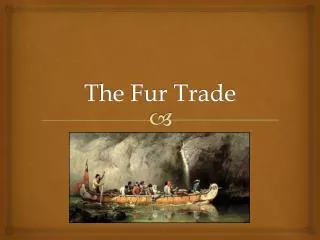

The Fur Trade
E N D
Presentation Transcript
Essential Question How did the Fur Trade, European settlement, and the rise of the Metis Nation transform the life for the peoples of the Northwest?
SIDENOTE: North America 16 beaver pelts = 1 musket Britain 1 beaver pelt = 16 muskets
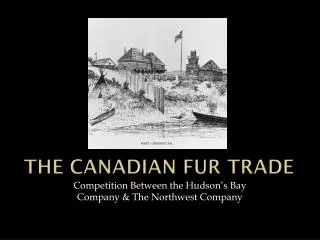
Two Fur Trade Giants The Hudson’s Bay Company The Northwest Company
Hudson’s Bay Company (HBC) • In 1668, businessmen from England (supported by the influence of Prince Rupert) financed a voyage to North America • Attempting to find a more efficient trading route through the north of Canada • St. Lawrence route was long and convoluted • Two ships: “The Eaglet” and “The Nonsuch”
Hudson’s Bay Company (HBC) • Only “The Nonsuch” arrived in Canada (the other ship turned back due to weather damage) • Crew landed in James Bay • Found rich fur trade opportunities with the Cree traders in the area
SIDE NOTE: The only life-size replica of “The Nonsuch” can be found in the Manitoba Museum.
Hudson’s Bay Company (HBC) • Returning to England with all of the furs, the businessmen asked the King for a trading monopoly • Sole trading rights to the land that drains into Hudson’s Bay • 1670, HBC is officially born
Advantages for HBC • Trading posts on the coast: • Cree trading partners trap furs and bring them to trading posts • HBC didn’t have to pay extra to send traders inland • Ships could travel quickly back to England through Hudson’s Bay (faster than the old St. Lawrence route)
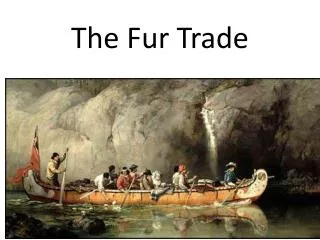
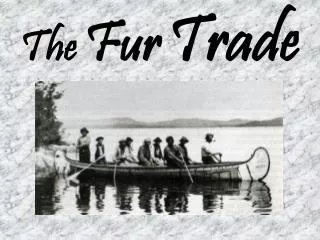
The Northwest Company (NWC) • Founded in the 1779 • A united group of British, Scottish, American, and French from the St. Lawrence region • Based in Montreal • Used St. Lawrence route to transport furs to England • Used in-land traders known as Nor’Westers or Voyageurs
The Northwest Company (NWC) • Attempt to compete with success of HBC • Between 1790 and 1791, NWC founders attempted to challenge the HBC fur-trade monopoly of Rupert’s Land • British government refused to do so • Each company had enforced boundaries where they were allowed to trap and trade
Advantages for NWC • Access to all of the inland areas not used by HBC • Vast amounts of territory • Exploited new fur sources in the West that had not been discovered by HBC
Disadvantages for NWC • Paying inland traders is more expensive (traders must travel for weeks at a time, need more supplies) • Voyageurs must bring furs all the way back to Montreal • St. Lawrence route back to England is slower and more convoluted than Hudson’s Bay route
HBC vs NWC: Fierce Rivalry • Attempts to move into each others territory • Burn each other’s boats and forts • Bribe the other company’s traders • Attempt to give better rates to the First Nations groups to win over their service
Some Impacts of the Fur Trade • Competition between the companies for furs and territory led to the European exploration of Canada West • Fur trade relationships formed the basis for many of the Aboriginal-European relationships at the time • Voyageurs lived among the Aboriginal cultures, eventually leading to the rise of the Metis culture • Combination of European and First Nations traditions
The Hudson’s Bay Company aka “The Bay” http://www.youtube.com/watch?v=apG-411fsVc