Welcome to Middle Ages
310 likes | 431 Vues
Explore key vocabulary from the Middle Ages, a crucial period in history from 800 to 1400 AD. This comprehensive guide covers essential terms such as 'apprentice', 'armor', 'chivalry', and 'serf', providing definitions and context. Learn about the feudal system, the roles of knights and lords, and the significance of guilds and manors, all of which shaped medieval society. Whether you are a student or enthusiast, this resource will enrich your understanding of the era's structure, culture, and language.


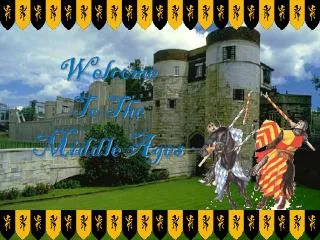
Welcome to Middle Ages
E N D
Presentation Transcript
Welcome to Middle Ages Vocabulary
apprentice - a beginner or novice who agrees to work for a master in his trade or craft in return for instruction and support
armor – protective clothing worn by the knight, may include a shield and lance
calligraphy – ornamental handwriting
castle • home to the king, lords and their families • often used a place of protection for the people of the manor
chivalry – the characteristics or rules of behavior expected of the knight: they include fairness, courtesy, respect, protection of the weak
Coat of Arms – the symbol used to identify the members of a noble family, often found on the shields of knights and on the outside of nobles’ homes
Crusader - a Christian soldier who fought in a holy War to free Jerusalem from the Muslims
Feudalism – a system where vassals (lesser nobles) held land from lords (nobles and the king) in exchange for protection and military service
fief – land held as a result of an agreement (pledge) between the vassal and the overlord, who pledges to honor and protect his vassal
guild - a group organized by merchants, artisans and craft worker to protect the members and set quality and price standards for all
heraldry – creating, recording and reading a Coat of Arms which identified member of the nobility
illuminations – designs, pictures, and decoration used in manuscripts to makethem more appealing
King – the ruler of the land, the top of the feudal pyramid
Knight - a trained horseman who fought for the king or his lord, a noble by birth
Lord - the second in order in the feudal world, a noble who owned less land than the king, and was loyal to the king
manor - a large self-sufficient estate or farm belonging to a noble family. Peasants and serfs worked the land and engaged in crafts to supply the lord and his family with all they needed in exchange for protection
Middle Ages – the name given to the time period between 800 and 1400 AD
moat – a large, deep ditch around the outside of the castle wall used as a means of defense against attack, sometimes filled with water
nobles - members of the wealthiest class in feudal society
serf a poor person who lives on and farms the land, they are not free, but belong to the land, one step above a slave. If the land is transferred they go with it.
peasants - a poor, but free people who live on the manor, and farm the land. They give crops and services to the Lord in exchange for protection
squire - a noble boy who is a servant to a knight as he is learning to be a knight himself Knight Quest http://library.thinkquest.org/J002767/index.htm
tapestry - heavy cloth woven with designs usually telling a story, hung on walls during the Middle Ages for warmth
tithe - one tenth of a person’s income or crops that went to the church
trade - the exchange of goods http://www.yesnet.yk.ca/schools/projects/middleages/town/town.html
page • a young noble boy who carried messages and waited • on the lord • - Learns social etiquette while sometimes studying to be a knight
vassal - in the Middle Ages, one who served the lord in exchange for land
Work Cited Slide 2 article.wn.com Slide 3 medieval.ucdavis.edu Slide 4 http://www.scademo.com/demo.calligraphy.php Slide 5 stevenville.com Slide 6 novaseeker.wordpress.com Slide 7 http://healeylibrary.wikispaces.com/HIST+320 Slide 8 http://www.flagshipfancydress.co.uk/medieval-st-george-crusader-costume-220-p.asp Slide 9 http://amedieval-blog.blogspot.com/2010/10/7th-grade-medeival-europe-webquest.html Slide 10 http://www.thefullwiki.org/Fiefdoms Slide 11 http://www.historyonthenet.com/shop/history/posters/medieval-posters/middle-ages-crafts-and-guilds-poster.html Slide 12 library.thinkquest.org
Work Cited Slide 13 library.thinkquest.org Slide 14 http://www.shoshone.k12.id.us/medieval/illumina.htm Slide 15 http://www.middle-ages.org.uk/king-john.htm Slide 16 http://www.tms.riverview.wednet.edu/lrc/middle_ages.htm Slide 17 http://www.protopage.com/middlemanor Slide 18 http://hector.ucdavis.edu/evenings/HISTORY/TTMA.htm Slide 19 http://www.ndaviess.k12.in.us/elemshare/Teachers/jweathers/Medieval.htm Slide 20 http://www.tumblr.com/tagged/Giovanni+Borromeo Slide 21 http://zh.sgforums.com/forums/10/topics/384797?page=8 Slide 22 http://www.virginiawestern.edu/faculty/vwhansd/his111/12_Medieval.html Slide 23 http://www.cumbavac.org/Middle_Ages.htm Slide 24http://www.oneyearbibleblog.com/2007/03/index.html Slide 25 Slide 25 http://www.talariaenterprises.com/product_lists/tapestry_9.html Slide 26 http://teachers.saschina.org/rderozario/personal-narrative-examples/ Slide 27 http://www.history-for-kids.com/knights-in-middle-ages.html Slide 28 http://www.buzzle.com/articles/medieval-serfdom-feudalism-in-the-middle-ages.html