
Plant Evolution
E N D
Presentation Transcript
Adaptations • Cuticle • alternation of generations • specialized tissues
Cuticle • Waxy coating on surfaces • resists drying out • stomata exist to allow necessary gas exchange
Alternation of generations • Plants live part of their life in a haploid stage and part in a diploid stage • haploid portion is called the gametophyte generation because it produces the reproductive cells • diploid portion called sporophyte generation because it produces spores
Alternation continued... • The gametophyte plant produces male and female sex organs (male and female gametangium) • eggs are fertilized by sperm to form a zygote • embryo development (seed) occurs within the female gametangium (see fig 23-1 on p 421, 23-5 on p 426 and 23-8 on p 430)
Specialized tissues • Other than bryophytes all other plants have vascular tissues • xylem - conducts water and minerals • phloem - conducts food
Bryophytes • Only nonvascular plants (mosses, liverworts) • no ability to internally transport water and materials • require moist environment • live in colonies, has rhizoids to anchor it • important in soil formation
Ferns • Seedless, flowerless, vascular plants • have xylem and phloem • has alternation of generation, the common familiar leafy plant is the sporophyte generation • has a rhizome and leaves
Ferns II • Spore production occurs on places on the fronds, sporangia are formed in which meiosis occurs to form spores. • Spores are often born in clusters called sori • spores are released and if they germinate will grow into the gametophytes • method of fertilization is primitive like bryophytes
Ferns • Whisk ferns - extinct, no roots, no leaves but did have vascular system above and below ground! • Horsetails - roots, rhizomes and vertical stems
Heterospory • Homospory - one type of spore produced by bryophytes and many ferns • Heterospory - some ferns have two types of spores produced microspores (male gametophytes) and macrospores (female gametophytes) • the development of heterospory leads two the two most successful kinds of plants
Gymnosperms • Vascular, seed bearing, flowerless plants • means “naked seed” • largest division is conifers - woody cone bearing gymnosperms • leaves are called needles • most have male and female parts on same plant. Reproductive parts in cone.
Gymnosperm reproduction • Microspores and macrospores formed in separate cones • Male cones smaller than female, on lower branches • meiosis in male cone produces a male gametophyte, also called a pollen grain • carried by air current to female gametophyte
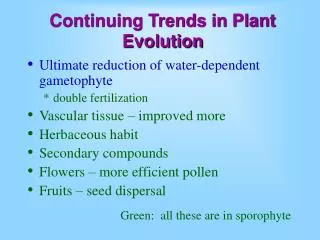
Angiosperms • Flowering, vascular plants • most successful plants • fertilization in flowering plants called double fertilization • 2 sperm involved - 1 fertilizes the egg, the other fuses with 2 cells in female gametophyte to form endosperm
2 classes of Angiosperms • Monocots - mostly herbaceous, long, narrow leaves, • parallel veination, • flower parts occur in threes, • single cotyledon (embryonic leaf), • endosperm present in seed • vascular bundles scattered
2 classes of Angiosperms • Dicotyledons - herbaceous or woody, • leaves variable in shape, • netted veination, • flower parts occur in 4 and 5, • 2 cotyledons, • endosperm usually absent in mature seed • vascular bundles arranged in a circle
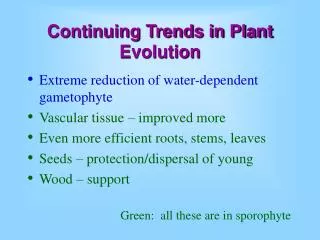
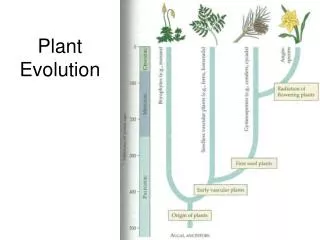
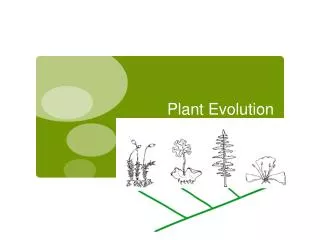
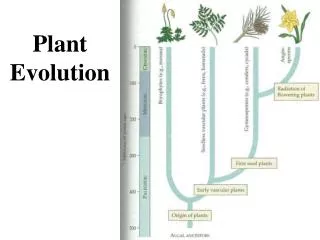
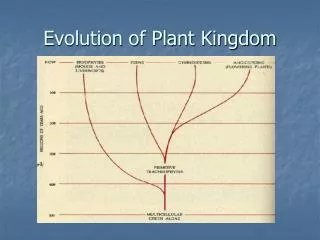
Plant Evolution • Bryophytes - no roots, leaves or stems, no vascular system, simple reproduction relying on water, gametophyte (haploid) dominant generation • Ferns - first vascular system, rhizomes (horizontal stems), fronds, sporophyte (diploid) dominant generation
Plant Evolution • Gymnosperms - first leaves (needles), vascular system, stems and roots, naked seeds • Angiosperms - vascular system more organized, leaves, ability to shed leaves, seed provided with nutritive tissues, flowers, more sophisticated reproductive methods