
Communities
This research explores the impact of hull design and operation on crew performance for high-speed craft, such as RNLI rigid inflatable boats and MOD interceptor craft. It encompasses full-scale measurements onboard and towing tank model experiments, leading to innovative design methods that enhance crew and passenger performance. Key findings reveal that severe motions and accelerations often exceed EU vibration limits in minutes. Ongoing efforts focus on improving operator performance through workload assessment and training, alongside collaborations with RNLI and the University of Chichester.

Communities
E N D
Presentation Transcript
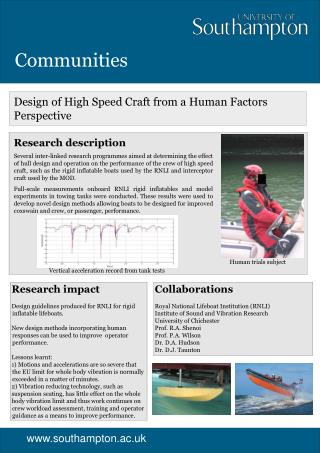
Communities Design of High Speed Craft from a Human Factors Perspective Research description Several inter-linked research programmes aimed at determining the effect of hull design and operation on the performance of the crew of high speed craft, such as the rigid inflatable boats used by the RNLI and interceptor craft used by the MOD. Full-scale measurements onboard RNLI rigid inflatables and model experiments in towing tanks were conducted. These results were used to develop novel design methods allowing boats to be designed for improved coxswain and crew, or passenger, performance. Human trials subject Vertical acceleration record from tank tests • Research impact • Design guidelines produced for RNLI for rigid inflatable lifeboats. • New design methods incorporating human responses can be used to improve operator performance. • Lessons learnt: • Motions and accelerations are so severe that the EU limit for whole body vibration is normally exceeded in a matter of minutes. • Vibration reducing technology, such as • suspension seating, has little effect on the whole • body vibration limit and thus work continues on crew workload assessment, training and operator guidance as a means to improve performance. Collaborations Royal National Lifeboat Institution (RNLI) Institute of Sound and Vibration Research University of Chichester Prof. R.A. Shenoi Prof. P.A. Wilson Dr. D.A. Hudson Dr. D.J. Taunton www.southampton.ac.uk