Communities
Community ecology focuses on the interactions and relationships among species within a community. It studies species richness, abundance, and diversity, encompassing various interspecific interactions such as predation, competition, and mutualism. Key concepts include the Competitive Exclusion Principle, ecological niches, and the processes of succession. This field explores how communities adapt and transition over time, from primary succession in lifeless areas to secondary succession following disturbances. Understanding these dynamics is crucial for conserving biodiversity and sustaining ecosystems.

Communities
E N D
Presentation Transcript
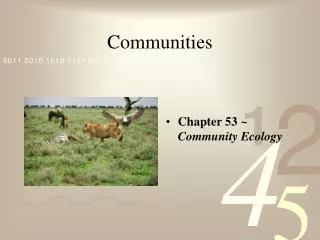
Communities • Chapter 53 ~ Community Ecology
Community structure • Community~ an assemblage of populations living close enough together for potential interaction • Richness (number of species) & abundance……. • Species diversity
Interactions • Interspecific (interactions between populations of different species within a community): •Predation including parasitism; may involve a keystone species/predator•Competition •Commensalism •Mutualism
Predation defense • Cryptic (camouflage) coloration • Aposematic (warning) coloration • Mimicry~ superficial resemblance to another species √ Batesian~ palatable/ harmless species mimics an unpalatable/ harmful model √ Mullerian~ 2 or more unpalatable, aposematically colored species resemble each other
Competition: a closer look • Interference~ actual fighting over resources • Exploitative~ consumption or use of similar resources • Competitive Exclusion Principle ~ 2 species with similar needs for the same limiting resources cannot coexist in the same place • √Gause experiment
The Niche • Ecological niche~ the sum total of an organism’s use of biotic and abiotic resources in its environment; its “ecological role” √ fundamental~ the set of resources a population is theoretically capable of using under ideal conditions √ realized~ the resources a population actually uses • Thus, 2 species cannot coexist in a community if their niches are identical Ex: Barnacle sp. on the coast of Scotland
Succession • Ecological succession~ transition in species composition over ecological time • Primary~ begun in lifeless area; no soil, perhaps volcanic activity or retreating glacier • Secondary~ an existing community has been cleared by some disturbance that leaves the soil intact