Earthquake Introduction Notes
Earthquakes are natural phenomena caused by the movement of the Earth's crust. As pressure builds, the crust eventually shifts, releasing energy as seismic waves. These waves vary in size, with larger quakes releasing more pressure than smaller ones. Earthquakes are measured using the Richter Scale, which quantifies magnitude, and the Mercalli Scale, which assesses intensity and damage. The focus is the underground starting point, while the epicenter is directly above on the surface. Understanding these concepts helps in grasping the destructive potential of seismic waves.

Earthquake Introduction Notes
E N D
Presentation Transcript
Causes of Earthquakes • As the crust tries to move, pressure builds • When crust finally moves, pressure and energy is released. • Released as Seismic Waves.
Different Sized Earthquakes • Bigger quakes release more pressure • Smaller quakes release less pressure • Pressure builds more when rocks in crust are very strong and bumpy. Since crust gets stuck and holds, more energy and pressure
2 Ways to Measure Earthquakes: • Richter Scale – Measures magnitude (strength) of quake. Based on how much energy is released. Each number on the Richter Scale represents an earthquake that is 10 times stronger. 3.0 quake is 10 times stronger than a 2.0 quake. 6.0 quake is 100 times stronger than a 4.0 quake.
2nd way to measure an earthquake: 2. Mercalli Scale – Measures intensity(amount of damage) of quake. Describes what the quake would feel like.
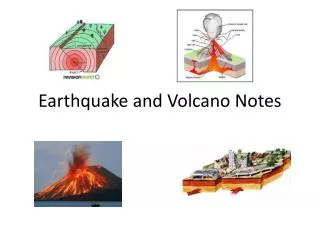
Where Earthquakes happen (copy picture) Focus- Point underground where land actually moves. Starting point of earthquake. Epicenter – point on Earth’s surface directly above the focus. The earthquake feels the strongest here.
Seismic Waves (Review): Waves of energy that travel through the Earth during an earthquake. (Three types: P, S, and Surface waves) P and S waves travel into and through the Earth. Surface Waves: The most destructive seismic waves, they travel across the surface of the Earth.