Neural Organization and Simple Reflexes
320 likes | 353 Vues
Learn about motor neurons, muscle spindles, stretch reflex, withdrawal reflex, crossed extensor reflex, and muscle spasms caused by reflex activation. Understand the cranial nerves controlling various functions.


Neural Organization and Simple Reflexes
E N D
Presentation Transcript
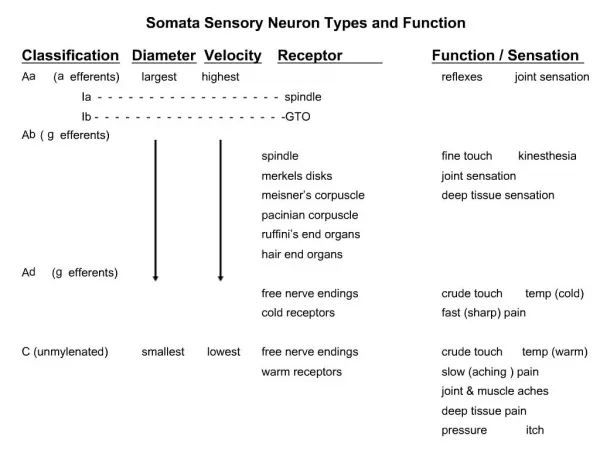
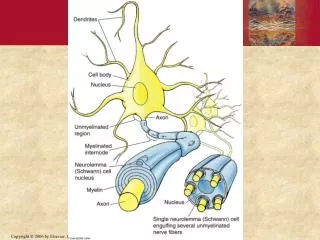
Anterior Motor Neurons • Alpha motor neurons • give rise to large type A alpha fibers (~14 microns). • stimulation can excite 3 - 100 extrafusal muscle fibers collectively called a motor unit • Gamma motor neurons • give rise to smaller type A gamma fibers (~5 microns) • stimulation excites intrafusal fibers, a special type of sensory receptor
The Muscle Spindle • - sense muscle length and change in length Figure 54-2; Guyton and Hall
Physiologic Function of the Muscle Spindle • Compares length between the intrafusal and extrafusal muscle fiber. • Opposes a change in length of the muscle. • When the muscle is stretched the spindle returns it to its original length. • Leads to the stretch reflex.
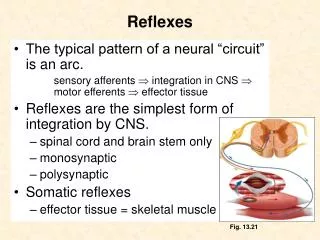
The Withdrawal Reflexes • A painful stimulus causes the limb to automatically withdraw from the stimulus. • Neural pathways for reflex: • nociceptor activation transmitted to the spinal cord • synapses with pool of interneurons that diverge the to the muscles for withdrawal, inhibit antagonist muscles, and activate reverberating circuits to prolong muscle contraction • duration of the afterdischarge depends on strength of the stimulus
Crossed Extensor Reflex • Painful stimulus elicits a flexor reflex in affected limb and an extensor reflex in the opposite limb. • Extensor reflex begins 0.2 - 0.5 seconds after the painful stimulus. • Serves to push body away from the stimulus, also to shift weight to the opposite limb.
Reflexes that Cause Muscle Spasm • Pain signals can cause reflex activation and spasm of local muscles. • Inflammation of peritoneum can cause abdominal muscle spasm. • Muscle cramps caused by painful stimulus in muscle: • can be due to cold, ischemia, of overactivity • reflex contraction increases painful stimulus and causes more muscle contraction
The Olfactory Nerve PLAY
Cranial Nerves Controlling the Extra-ocular Muscles PLAY Figure 14.23
The Trigeminal Nerve PLAY
The Facial Nerve PLAY
The Vagus Nerve PLAY