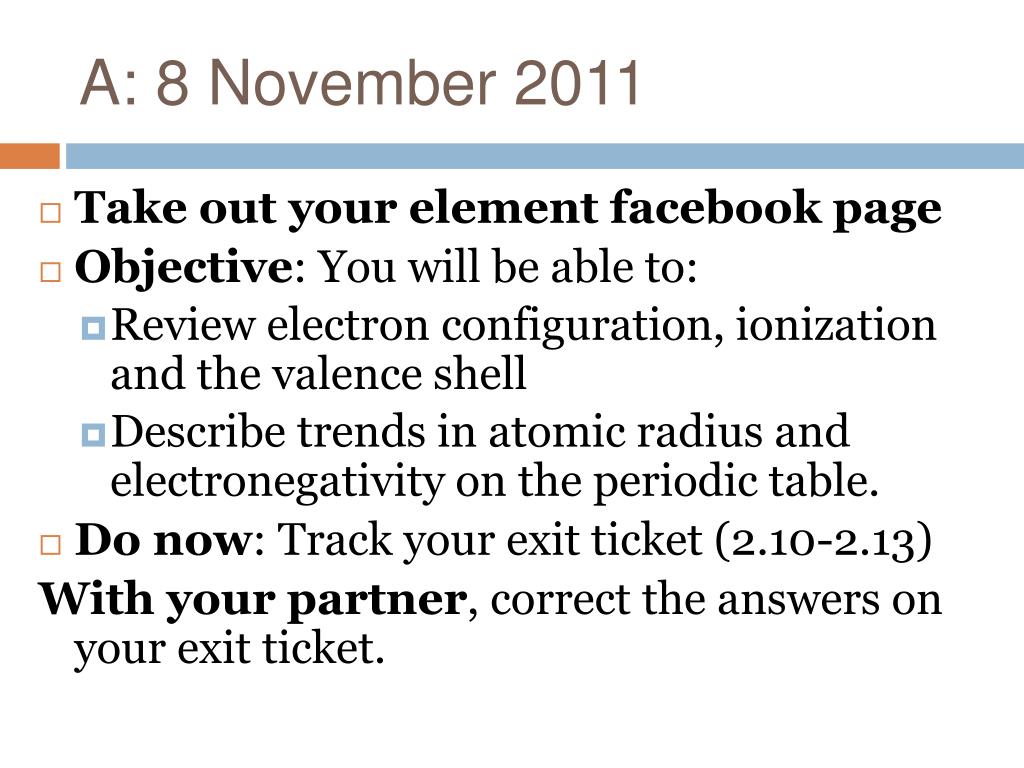
A: 8 November 2011. Take out your element facebook page Objective : You will be able to: Review electron configuration, ionization and the valence shell Describe trends in atomic radius and electronegativity on the periodic table. Do now : Track your exit ticket (2.10-2.13)
Une image / un lien ci-dessous est fourni (tel quel) pour télécharger la présentation
Politique de téléchargement : le contenu du site vous est fourni TEL QUEL pour votre information et votre usage personnel ; il ne peut être vendu, concédé sous licence ni partagé sur d’autres sites sans l’accord de son auteur.Le contenu vous est fourni TEL QUEL, pour votre information et votre usage personnel uniquement.Téléchargez la présentation en cliquant sur ce lien.Lors du téléchargement, si vous ne parvenez pas à télécharger une présentation, l’éditeur a peut-être supprimé le fichier de son serveur.Pendant le téléchargement, si vous ne parvenez pas à obtenir une présentation, le fichier a peut-être été supprimé par l’éditeur.
F I N
Plus de contenu associé
Transcription de la présentation
A: 8 November 2011 • Take out your element facebook page • Objective: You will be able to: • Review electron configuration, ionization and the valence shell • Describe trends in atomic radius and electronegativity on the periodic table. • Do now: Track your exit ticket (2.10-2.13) With your partner, correct the answers on your exit ticket.
Agenda • Do now • Review for quiz • Unit 3 Objectives! • Trends in atomic radius and electronegativity Homework: Element Facebook Page: tomorrow Unit 2 Quiz Objectives 2.7-2.13 tomorrow
Quiz Review – in your notebook • Draw the orbital notation for oxygen. • Electrons are represented by ______. • Each individual box represents ______. • Write the electron configuration notation for oxygen. • Circle the valence shell • What does the “1” stand for? “s”? “2”? • How many valence electrons does it have? • Draw its dot diagram.
What do the dots represent? • How many protons does oxygen have? • Draw a picture of oxygen that shows the energy levels. Now, turn it into an ion of oxygen. • Write the electron configuration for the oxygen ion. • Write the symbol with the charge for the oxygen ion.
If you finish early… • Work on your Element Facebook page • Start on the packet I just left on your desk • Study for a quiz you need to retake • Do other work silently
A: 9 November 2011 • Take Out Homework: Element facebook page • Objective: You will be able to: • show what you know about electron configuration and ions • describe and sketch trends in electronegativity and atomic radius • Do now: What is one thing that atoms and ions have in common? One difference?
Agenda • Do now • Objectives 2.7-2.13 Quiz • Trends on the periodic table • Graphing and analyzing trends: Example • Finish graphing and analyzing trends Homework: Graphing and Analyzing Trends: tomorrow
Quiz • When you finish, silently: • Turn it over on your desk. • Track your 2.1 to 2.6 quiz that you just got back. Keep out your tracking sheet for stamps! • Stack up all your Unit 2 papers (Quizzes, Homework, Labs…) and paperclip them together. Put the Unit 2 Mastery Tracking Sheet on Top! • Start the Trends on the Periodic Table worksheet or • Work on other work
Atomic radius • As you move down the periodic table, more energy levels are added • This increases the size of the atom • As you move left to right across a period, more electrons are added to the SAME energy level • There is increasing attraction between more electrons and the positive nucleus • Atom size decreases!
Electronegativity • The ability of an atom to attract electrons to itself. • Elements that want to lose electrons have lowelectroneg., • Elements that want to gain electrons have highelectroneg. • Increases going up a group • Increasesgoing across a period • The smaller the atom, the easier it can attract other electrons • Most reactive: F • Least reactive: Fr
Trends on the Periodic Table • With your partner and your periodic table, complete the front, ranking each row in order of increasing atomic radius. • Then, complete one table on the back using the special periodic table • Then, we’ll do one graph and analysis together.
A: 11 November 2011 • Take Out Homework: Trends on the Periodic Table Graphing • Objective: You will be able to: • differentiate between ionic and covalent bonding and predict bond type • Do now: Write the symbol for the ion formed by calcium. Explain how you determined your answer.
Agenda • Do now, collect homework • Ionic vs. covalent bonding: examples, modeling and practice problems • Exit Ticket Homework: Week 10/11 Homework #1-12: due Monday
Ionic Bonding • To gain or lose electrons, atoms need to give or take them from other atoms • Ionic bond – one atom gives one or more electrons to another atom • The oppositely charged ions are attracted to one another (electrostatic attraction) • this causes them to become bonded together • Ions will transfer electrons (and bond) so that they both get 8 valence e-
Ionic Compounds • How do you know if a compound is ionic? • One cation (left/middle of periodic table) + One anion (right of periodic table or a polyatomic anion) • Transfer electrons so that both atoms have a full valence shell. • Are bonded by electrostatic attraction.
A: 15 November 2011 • Take Out Homework: Week 10/11 #1-11 • Objective: You will be able to: • differentiate between ionic and covalent bonds and write names for ionic compounds. • Do now: An atom of calcium meets an atom of sulfur. Describe what happens and what type of bond they make. (2 complete sentences)
Agenda • Do now/homework check • Review ionic vs. covalent bonding • Naming ionic compounds: examples and practice problems • Hand back and track quizzes, celebrate progress Homework: Week 10/11 Homework #12-13: Weds. Quiz Thurs. Obj. 3.1-3.4
Ionic or Covalent? • In your notebook, copy each example. Then, write an “I” for ionic or a “C” for covalent • NaCl • NO2 • N2Br • NaI • KNO3 • CaS • H2O • Cl2 • Cu(OH)2 • CCl4
Naming ionic compounds • Write the cation name • Name of the element • Write the anion name • Beginning of element name + -ide • Ex 1: LiCl • Ex 2: Al2O3
Ionic or Covalent? • In your notebook, copy each example. Then, write an “I” for ionic or a “C” for covalent • NaCl • NO2 • N2Br • NaI • KNO3 • CaS • H2O • Cl2 • Cu(OH)2 • CCl4
A: 16 November 2011 • Take Out Homework: Week 10/11 #12-13 • Objective: You will be able to • write formulas and names for ionic compounds • Do now: Ionic or covalent? • a. CaCl2 • b. CO2 • c. AlF3
Agenda • Do now/homework check • Exit ticket • Writing formulas for ionic compounds • Practice problems • Ionic bonding “speed dating” • Formulas for ionic compounds assignment Homework: Week 10/11 Homework p. 4 Quiz tomorrow (Obj. 3.1-3.4)
Exit Ticket • When you finish, paperclip all your unit 2 materials together and raise your hand. • I’ll give one person at a time permission to put them in your green folder
Writing Formulas for Ionic Compounds • Write each ion symbol with the charge • “Cross” the charges down to the bottom of the opposite element • Rewrite symbols with subscripts • Do not write + or –, or 1 Examples: Ex 1: aluminum oxide Ex 2: lithium sulfide Ex 3: magnesium oxide
IONS SPEED DATING • Fill in your 2 ion cards (6 minutes) • Mingle with your classmates to make 10 ionic compounds. Fill in all four columns of the chart. • Cation (+) FIRST! • Each correctly named compound will earn you 10 points. Each compound over 10 will earn you bonus points! • Check to be sure you write the CATION first! • If you run out of combinations, trade an ion with a classmate. Objective: SWBAT model atomic structure and relate valence shell electrons to trends on the periodic table.
Before the end of the period Stay in your seat and… • Finish Week 10 HW Page 4 and get it stamped! • Be sure your mastery tracking sheet from Unit 2 is stamped • Organize your Unit 2 materials and paper clip them. • Leave them in your green folder. (One person up at a time, please) • Work quietly on other work
Homework • Week 10/11 Homework p. 4: tomorrow • Quiz on 3.1-3.4: tomorrow
Connexion au compte
Connectez-vous pour publier votre contenu sur SlideServe.