Download
1 / 28
280 likes | 385 Vues
This study focuses on the identification and reconstruction of short-lived resonances such as K*(892), Λ(1520), and ϕ(1020) in proton-proton collisions at 900 GeV and 14 TeV. Using a detailed strategy involving mixed-event techniques and realistic simulations, we extracted resonance yields, pT distributions, and particle ratios. The results are derived from extensive data sets analyzed using advanced algorithms, including neural networks for improved track selection. The findings provide valuable insights into the production mechanisms of these resonances in high-energy collisions.

E N D
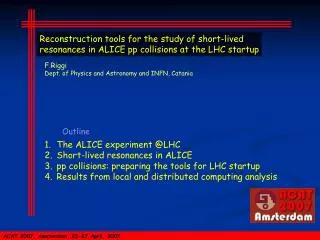
Reconstruction of short-lived resonances in pp collisions F.Blanco – INFN e Università di Catania - Italy • Content • Identification strategy • Code development • Results on resonances (K*(892),(1520),(1020),..) from simulated p-p events @ 900 GeV and @14 TeV • Summary and Outlook Convegno Nazionale Fisica di Alice, Frascati, 12-14 Novembre 2007
Signal extraction Inside same event, correlations between K+ and π- candidates K- and π+ candidates Evaluate invariant mass spectrum Example: K*(892) Kπ (~100%) Mixed-event technique Combinatorial background: Like-sign technique
Study of the combinatorial background by the mixed-event technique Studied dependence on event selection criteria ●Charged multiplicity ●z-vertex location Only events with Δm<5 and Δzv < 3 cm mixed Multiplicity Comparison of the event mixing background to the “true” combinatorial backgroung ‘True’ background = (Signal) – (True pairs) z-vertex
Effect of event selection on mixing procedure (True Background) (Mixed events background) Only events with Δm<5 and Δzv < 3 cm mixed No event selection
K* K* Like-sign technique also explored Unlike-sign Like-sign Comparison of the like-sign background to the “true” combinatorial background
Perfect PID Realistic PID True PID influence on K*(892) reconstruction Found No thresh on maxprob Maxprob > 0.7 (K) Maxprob > 0.7 (π) Maxprob > 0.7 (K) No PID (π) Perfect PID Realistic PID True K* = 7599 Found K* = 7488 S/B = 0.138 S/√B = 30.68 True K* = 4306 Found K* = 4139 S/B = 0.11 S/√B = 20.28
How the code works Selection of primary and identified tracks: AliRsnReaderRL From generation and reconstruction AOD: Analysis Object Data: AliRsnEvent, contains arrays of AliRsnDaughter objects ESD: Event Summary Data Kinematics Analysis, Cuts,histograms,… AliRsnAnalysis …
Results from p-p events @ 900 GeV and 14 TeV • Events of PYTHIA were generated and fully reconstructed using • Realistic simulation of the detector response for the whole ALICE assembly • Realistic clusters and tracks reconstruction 2 Data Sets 2 x 10⁵ minimum bias p-p PHYTIA events @ 900 GeV. Running scenario at LHC startup 1.5 x 10⁶ minimum bias p-p PHYTIA events @ 14 TeV (about 0.2% 1-year data taking) PDC06 data, distributed GRID analysis
K*(892) results with realistic PID True K* (within 2σ) = 4728 Found K* (within 2σ) = 4274 S/B = 0.105 S/√B = 20.12
(1020) and (1520) with realistic PID True (± 2σ) = 186 Found (±2σ) = 168 S/B = 2.87 S/√B = 13.86 True Λ (±2σ) = 146 Found Λ (±2σ) = 128 S/B = 1.23 S/√B = 19.5 *
Yields and particle ratios uncertainties Resonance Discrepancy w.r.t. true pairs K* 4 % Φ 10 % Λ* 12 % Particle ratios Statistical K*/K- 1.6 % Λ*/Λ 9 % Φ/K* 8 % Φ/Λ* 12 % K*/Λ* 9 %
K*(892)± analysis K*(892)± KS0 + π± B.R. ~33% Total B.R. ~ 23 % π+ + π- B.R. ~ 69% Need to identify the associated V0 They are reconstructed by association of two opposite charge tracks, and then applying some topological cuts
Results on charged K*(892) PPR cuts cosθp > 0.994 dca < 3.46 cm r > 0.34 cm b+/- > 0.0115 cm Efficiency = 52.0 % Purity = 97.9 % 0.48 < m < 0.51 GeV 3042 KS0 reconstructed (2978 true)
Neural network approach to V0 finding Aim: ● Improve V0 selection (efficiency & purity) by ANN ● Combine V0 with pion tracks bj = tanh (∑ wij ai – Θj) output = ∑ wk bk w’s = synaptic weights Θ = neuron thresholds ai = input bi = hidden layer Various possibilities for the training algorithm exploited, BFGS chosen 7 inputs, 1 hidden layer
Results on charged K*(892) using ANN approach True and found K*(892)± V0 selection strategy True K* Found K* Notes PPR cuts 944 1042 Overestimated yield/width ANN 1122 1173 Reason. agreement, best present condition Yield improvement by 15-20% with respect to PPR Reasonable agreement between true and found K*
(1020) and *(1520) with realistic PID (1020) (1520) True =4893 Found =4967 True *=3879 Found *=3649
K*(892) with realistic PID Found K*(±2)=89182 True K*(±2)=85360 Mass resolution ~ 3MeV/c2
pT= 0 - 0.5 pT= 1.5 - 2 pT= 3.5 - 4 K*(892)0 pT-analysis with realistic PID
Looking for f0(980) 100k pp events @14 TeV
Summary • Short-lived resonances in pp collisions @ LHC energies could be studied in ALICE from the very beginning • With a small sample of events [O(105)] @ 900 GeV and realistic PID: • ● Extraction of yields at least for K*(892), Φ(1020), Λ*(1520) • ● Rough pT - distribution for K*(892) up to 1.5 GeV/c • ● Particle ratios Φ/K*, Λ*/K*, Φ/Λ* measurable • Analysis of O(106) pp events at 14 TeV fully reconstructed on the GRID • ● Resonance yields with large statistics • ● pT-analysis of K*(892)0 • ● Correction matrix (y,pT) • Extension to other resonances (Σ(1385), Δ, f0(980)) is in progress.
Neural network approach to charged K*(892) reconstruction Huge background