Animal Kingdom Phyla: Diversity and Characteristics
150 likes | 180 Vues
Explore the 9 main phyla of the Animal Kingdom, such as Porifera, Cnidaria, and Arthropoda, each with unique structural and functional properties. Learn about the abundance and diversity of species within these phyla.


Animal Kingdom Phyla: Diversity and Characteristics
E N D
Presentation Transcript
Animal Kingdom How do animal populations differ?
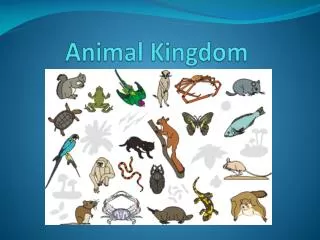
Kingdom Animalia • Within the Animal Kingdom there are approximately 35 sub-divisions called “Phyla”; each phylum sub-division shares particular structural and functional properties which together separate it from other phyla. • There are 9 main phyla in the Animal kingdom:
Kingdom Animalia • Porifera – These are the salt-water sponges; there are approximately 8,000 separate species existing today.
Kingdom Animalia • Porifera – These are the salt-water sponges; there are approximately 8,000 separate species existing today. • Cnidaria- This group is composed of jellyfish, and other lower aquatic animals; approx 15,000 species exist today
Kingdom Animalia • Porifera – These are the salt-water sponges; there are approximately 8,000 separate species existing today. • Cnidaria- This group is composed of jellyfish, and other lower aquatic animals; approx 15,000 species exist today • Platyhelminthes – These are the flatworms which inhabit both marine and freshwater habitats; over 15,000 species exist today.
Kingdom Animalia • Porifera – These are the salt-water sponges; there are approximately 8,000 separate species existing today. • Cnidaria- This group is composed of jellyfish, and other lower aquatic animals; approx 15,000 species exist today • Platyhelminthes – These are the flatworms which inhabit both marine and freshwater habitats; over 15,000 species exist today. • Nematodes – This phylum consists mainly of about 80,000 known parasitic worms.
Mollusca– This major group consists of snails, clams, squid, and octopus; there are over 110,000 known species.
Mollusca– This major group consists of snails, clams, squid, and octopus; there are over 110,000 known species. • Annelida – About 15,000 individual segmented worms comprise this phylum; the common earthworm is an example. • .
Mollusca– This major group consists of snails, clams, squid, and octopus; there are over 110,000 known species. • Annelida – About 15,000 individual segmented worms comprise this phylum; the common earthworm is an example. • Arthropoda– This very large group consists of insects; it is estimated that there are over 1 million species of insects existing today.
Echinodermata – These are the marine starfish; about 6,000 species exist today.
Echinodermata – These are the marine starfish; about 6,000 species exist today. • Chordata – This is a group of animals which are classified on the basis of possessing 3 common embryological features – dorsal nerve cord, supportive structure called the notocord, and pharyngeal gill pouches. Within this phylum is a highly-advanced group called the `vertebrates' which include fish, amphibians, reptiles, birds, and mammals; it is this phylum to which the human organism belongs.
Phylum Porifera - Sponges • Structure • Bodies of sponges are supported by a network of spikes. • Has pores
Phylum Porifera - Sponges • Reproduction • Asexually by budding • Sexually • Sponges do not have separate sexes but a single sponge produces eggs at one time of the year and sperm at a different time.
Phylum Porifera - Sponges • Getting Food and Oxygen from Water • Feed by straining food particles from water • Oxygen from the water moves into the sponges cells • Move reproductive cells