Analyzing Force on a Bend in Water Flow at 95°C with Pressure Variation
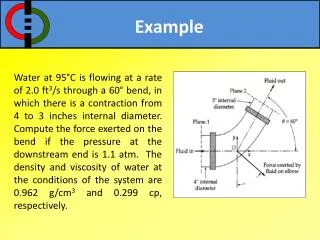
This problem involves calculating the force exerted on a 60° bend in a steady-state flow of water at 95°C, where it contracts from an internal diameter of 4 inches to 3 inches. The flow rate is 2.0 ft³/s, and the pressure at the downstream end is 1.1 atm. Given the density and viscosity of water at these conditions (0.962 g/cm³ and 0.299 cP, respectively), the objective is to determine the resultant forces on the bend, excluding frictional and gravitational effects.

Analyzing Force on a Bend in Water Flow at 95°C with Pressure Variation
E N D
Presentation Transcript
Example Water at 95°C is flowing at a rate of 2.0 ft3/s through a 60° bend, in which there is a contraction from 4 to 3 inches internal diameter. Compute the force exerted on the bend if the pressure at the downstream end is 1.1 atm. The density and viscosity of water at the conditions of the system are 0.962 g/cm3 and 0.299 cp, respectively.
Example A jet of water having a velocity of 30 m/s and a diameter of 2.5 cm is deflected by a smooth, flat vane, where there are no changes in elevation or pressure before and after impact. What is the force of the jet on the vane?
Quiz Water is flowing at steady state through a reducing bend as shown below. The angle 2 = 90, and the pressure at point 2 is 1.0 atm abs. The flow rate is 0.020 m3/s and the diameters at points 1 and 2 are 0.050 m and .030 m, respectively. Neglect frictional and gravitational forces. Calculate the resultant forces on the bend. TIME IS UP!!!